
Solar Battery Maintenance: The Essential Guide to Protecting Your Investment

Most homeowners believe that keeping their energy storage system running is a matter of physical cleaning, but the reality of solar battery maintenance is far more digital and environmental than you might expect. It’s completely normal to feel a bit of "battery anxiety" after making such a significant investment in your home’s future. You’ve likely heard confusing technical jargon from various installers or worried about the potential for an expensive failure if you miss a single check. We understand that you want your system to work reliably without needing an engineering degree to look after it.
Our expert guide cuts through the noise to show you how to maximise the lifespan and safety of your system specifically within the harsh Australian climate. You’ll learn how to get the maximum return on your solar investment while enjoying total peace of mind regarding fire safety and reliability. We will outline a clear routine for checking your system health, clarify what you can safely do yourself, and identify when it’s time to call in a professional. By the end of this article, you’ll have a straightforward plan to keep your power flowing and your investment protected for years to come.
Table of Contents
What is Solar Battery Maintenance and Why is it Vital?
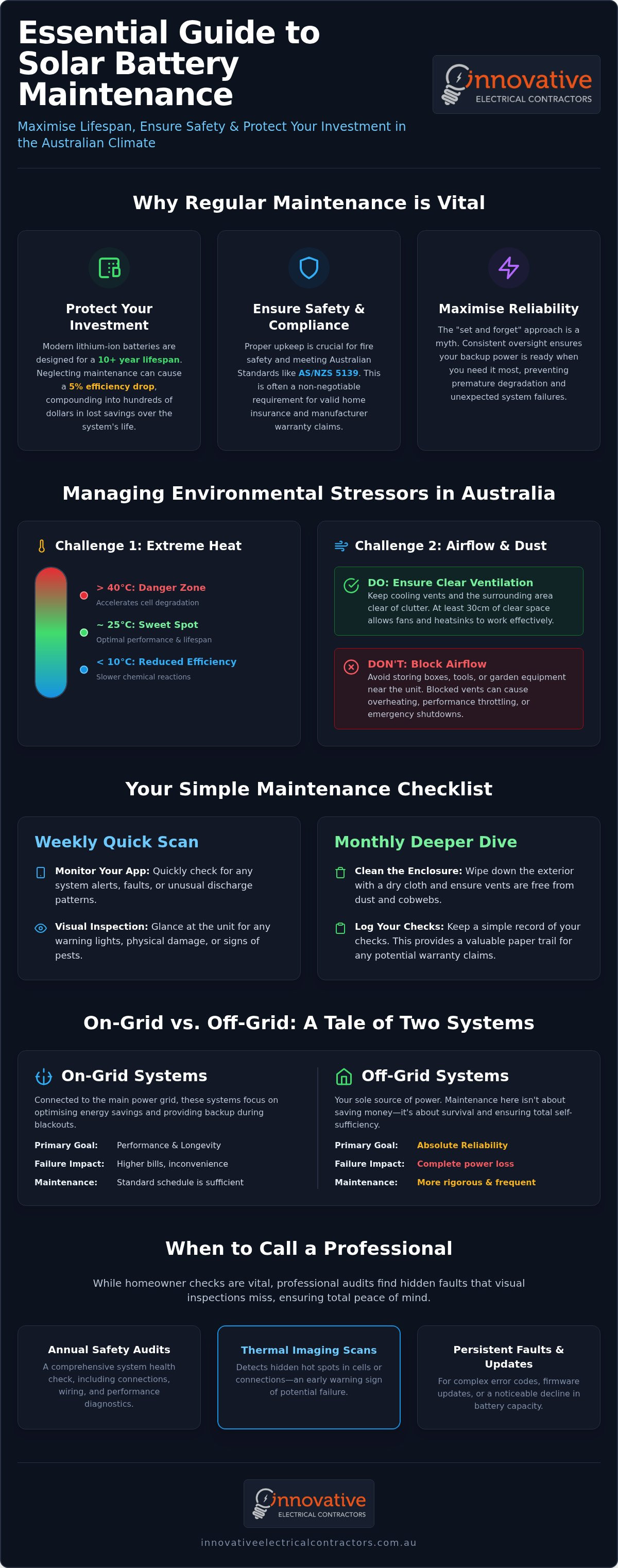
Effective solar battery maintenance is a proactive strategy combining digital monitoring, physical inspections, and environmental control to ensure your system performs at its peak. While many installers pitch these systems as "set and forget," that's a dangerous myth. Modern lithium-ion units require consistent oversight to reach their 10 plus year life expectancy. Without it, you risk a slow decline in performance that most homeowners don't notice until it's too late. It’s about being a responsible owner to ensure your backup power is there when you actually need it.
Protecting your return on investment is the primary goal. A small 5% drop in efficiency caused by poor ventilation or software lag might seem minor today, but it compounds over thousands of cycles. This results in hundreds of dollars in lost energy savings over the life of the system, making performance optimisation a priority. Beyond the financial aspect, adhering to Australian Standards like AS/NZS 5139 is essential. This standard governs the safe installation and maintenance of battery systems. Staying compliant isn't just about safety; it's often a requirement for insurance coverage and valid warranty claims.
Understanding Battery Degradation in Australia
Every time your battery charges and discharges, it completes a "cycle." This involves complex chemical reactions within the cells. You can gain a deeper perspective by understanding rechargeable battery types and how their chemistry differs. In Australia, our extreme ambient temperatures accelerate these reactions, which can lead to premature degradation. Managing your Depth of Discharge (DoD) is also vital. Consistently draining your battery to 0% puts immense stress on the unit, significantly shortening its "cycle life" compared to systems that stay within recommended limits.
The Role of the Manufacturer Warranty
Your warranty is your safety net, but it's not unconditional. Most major manufacturers include "neglect" clauses that can void your protection if you haven't performed basic upkeep. They expect you to show "reasonable care," which usually means keeping the unit free from dust and ensuring it operates within specific temperature ranges. Keeping a simple log of your solar battery maintenance activities and professional health checks provides the paper trail needed if you ever need to make a claim. It turns a potential dispute into a straightforward process, ensuring you aren't left out of pocket for a hardware fault.
Managing Environmental Stressors: Heat, Dust, and Airflow
Australia’s climate is world-class for solar production, but it's incredibly demanding on storage hardware. While your panels sit on the roof, your battery is often tucked away in a garage or on an external wall where environmental factors can quietly degrade its internal chemistry. Effective solar battery maintenance begins with controlling the immediate atmosphere around the unit. Most lithium-ion systems are designed to operate optimally at 25°C. When ambient temperatures soar past 40°C during a typical Aussie summer, chemical ageing accelerates, reducing the total energy the cells can hold over time.
Ventilation is your first line of defence against this heat. Modern units rely on heatsinks and internal fans to shed excess warmth during heavy discharge periods. A common mistake is allowing household clutter to pile up around the enclosure. Boxes, garden tools, or workshop equipment can block airflow, forcing the battery to throttle its performance or shut down entirely to prevent damage. This is a crucial part of broader solar PV system maintenance that ensures every component of your energy setup remains functional and safe.
Thermal Management Strategies
Optimising the environment is often more effective than trying to cool a battery after it's already hot. If your system is installed externally, ensure it has adequate shading from the afternoon sun. For high-performance setups in the hottest regions, active cooling solutions or additional insulation in the mounting area might be necessary. You should regularly check your system app to monitor internal temperature sensors. If you notice the battery consistently running hot, it might be time to consult a solar expert to evaluate your installation's airflow.
Keeping the Enclosure Secure
Dust and debris are silent killers, particularly for regional or off-grid Australian properties. Fine red dust can penetrate small gaps, coating circuit boards and acting as a thermal insulator that traps heat. You should also keep an eye out for vermin. Mice and spiders find the warmth of a battery enclosure very attractive, but chewed wiring or thick webs in ventilation grilles can cause catastrophic failures. Use these steps to keep the unit secure:
Wipe the exterior: Use a damp cloth to remove dust without using high-pressure water.
Inspect seals: Check that rubber gaskets aren't perishing or cracking under UV stress.
Clear grilles: Gently brush away cobwebs or debris from air intake points.
Taking these small steps as part of your solar battery maintenance routine prevents minor environmental issues from turning into expensive repairs. It ensures your system remains a reliable asset rather than a liability.
The Homeowner Maintenance Checklist: Steps for 2026
By 2026, energy storage technology has become more integrated into our smart homes, making data the core of your solar battery maintenance strategy. Keeping your system in top shape doesn't have to be a full-time job. A structured routine ensures you catch minor issues before they become major expenses. This proactive approach guarantees your backup power remains ready for any unexpected grid outages while maximising your long-term savings.
Weekly Digital Health Check: Open your monitoring app to review discharge patterns. Spotting anomalies early prevents deep-cycle damage.
Monthly Visual Inspection: Walk around the unit to check for external wear. Look for "hot spots," discolouration on the casing, or frayed external cables.
Quarterly Environment Clear-out: Ensure the area remains clear. Remove any new storage items, cobwebs, or dust build-up that might restrict airflow.
Annual Professional Review: Schedule a licensed electrician for internal testing. Professional diagnostic tools can identify cell imbalances that apps might miss.
Firmware Updates: Check for Battery Management System (BMS) updates. These software patches often optimise charging algorithms and improve safety protocols.
Interpreting Your Monitoring App Data
Your app is your most powerful tool for solar battery maintenance. A healthy discharge curve should look smooth and consistent with your daily household usage. If you notice sharp, jagged drops in stored energy, it could indicate a failing cell or a software glitch. You should also look for "vampire loads." These are small, constant power drains from appliances that might be pulling your battery lower than intended overnight. Most modern apps allow you to set push notifications for temperature spikes or system faults. Use these alerts to stay ahead of potential failures.
Safe Visual Inspection Protocols
Safety is the priority during any physical check. For your protection, the "No-Touch" rule applies to all internal components: homeowners should never open the battery casing or attempt to manipulate internal wiring. Your role is to be the "eyes" of the system. Look for signs of corrosion on visible terminals or the mounting rack, which can occur in humid or coastal environments. If you ever smell "rotten eggs" (sulphur) or a sharp, metallic ozone scent near your storage, shut the system down immediately. These smells are early warning signs of chemical leaks or electrical arcing that require an urgent professional inspection.
Comparing Maintenance: On-Grid vs. Off-Grid Systems
Not all storage setups are created equal. If you're on-grid, your solar battery maintenance focuses primarily on economic optimisation and backup readiness. You want to ensure the system is primed for a blackout and is discharging effectively to dodge peak electricity rates. It's a smart financial tool that requires regular but relatively straightforward oversight. You're looking for the best return on investment while keeping a safety net for those rare times the grid goes down.
For off-grid owners, the stakes are significantly higher. Reliability is a matter of survival. If your system fails, the lights go out, the fridge stops, and essential water pumps might cease. In these scenarios, maintenance is non-negotiable. You also need to consider generator integration. A well-maintained generator is a battery’s best friend. It prevents deep-discharge events during long periods of overcast weather, which protects the cells from permanent capacity loss and ensures you aren't left in the dark.
Depth of Discharge (DoD) management also differs between the two. On-grid users can often push their batteries harder because the grid acts as a safety net if they run low. Off-grid users must be more conservative with their energy budget. Consistently draining your bank too low will lead to a premature and very expensive replacement that could have been avoided with better monitoring habits.
Specific Needs of Off-Grid Battery Banks
Older lead-acid or gel banks require physical checks that lithium users don't face. This includes terminal tensioning and equalisation charges to prevent sulfation. While modern lithium systems are less hands-on, they require sophisticated monitoring to stay balanced. Ensuring you have modern electrical services tailored for off-grid living is the best way to ensure long-term reliability. We often find that systems fail not because of the hardware, but because the integration between the solar, battery, and backup generator wasn't maintained as a single, cohesive unit.
When to Call a Professional
While your app shows the "State of Charge" (SoC), a professional audit measures the "State of Health" (SoH). SoC tells you how much "fuel" is in the tank right now. SoH tells you how much the "tank" itself has shrunk since installation. Identifying "weak cells" in a multi-module string is critical. One bad module can drag down the performance of the entire bank. We also recommend re-calibrating the BMS after a significant power surge or system event to ensure the digital monitoring remains accurate. If you're relying on a complex off-grid setup, book a professional health check to ensure your power remains dependable.
Professional Care: The Innovative Electrical Contractors Approach
While your weekly app checks provide a great baseline, professional solar battery maintenance requires a deeper technical dive to ensure long-term safety. At Innovative Electrical Contractors, we go beyond simple visual inspections. Our team conducts comprehensive safety audits that align with the latest Australian Standards, specifically AS/NZS 5139. This ensures your system isn't just working; it's fully compliant with insurance and safety regulations. We pride ourselves on being the reliable local expert you can depend on for complex energy systems.
We use advanced diagnostic tools like thermal imaging to identify hidden issues that a standard homeowner check would miss. These cameras spot "hot spots" in your wiring or battery modules before they become significant hazards. By catching these thermal anomalies early, we prevent electrical fires and hardware failures. We also examine your switchboard integration. Your switchboard is the heart of your home’s electrical system. It must be able to handle the high throughput of a modern battery without overheating or tripping under load.
Our Professional Maintenance Service
Our standard health check is methodical and results-driven. We include specific tests that guarantee your system's reliability, such as:
Islanding Function Testing: We verify that your system correctly disconnects from the grid and powers your home during a blackout.
Safety Switch Audits: Testing all protective devices to ensure they trip at the correct thresholds.
Compliance Verification: Ensuring your installation still meets the evolving Australian safety standards to protect your warranty and insurance.
This thorough approach provides the peace of mind that your investment is performing exactly as it should. We don't just look for faults; we look for ways to optimise your system's efficiency.
Future-Proofing Your Energy Storage
Your energy needs might change as your family grows or you invest in an electric vehicle. We provide expert advice on system expansions and adding more modules to your existing bank safely. Modernising your setup with smart home integration can also help you manage energy more efficiently by automating discharge during peak price periods. Our national expertise means we understand the unique challenges faced by Australian homes and commercial properties alike. Organise a professional solar battery health check with our expert team today.
Securing Your Energy Independence for the Long Haul
Your solar battery is the heart of your home’s energy independence, but it requires consistent care to survive the Australian climate. By combining weekly digital monitoring with monthly visual inspections, you can catch minor issues before they lead to system failure. Effective solar battery maintenance is a partnership between your own observations and professional expertise. While you can manage the environment and airflow, only a licensed specialist can verify internal cell health and ensure your system meets the latest safety standards. This proactive approach is the best way to safeguard your investment and ensure your power remains dependable.
As accredited solar and battery specialists, we bring extensive expertise in complex off-grid and commercial systems to every project. We are committed to maintaining the highest Australian safety and compliance standards for your peace of mind. Get a professional solar battery assessment from Innovative Electrical Contractors to ensure your energy storage system remains a reliable asset for years to come. With the right care, you'll enjoy a safer, more efficient home and a maximum return on your investment.
Frequently Asked Questions
How often should I have my solar battery professionally serviced?
Professional servicing should occur once every 12 months to ensure your system remains safe and compliant with AS/NZS 5139. During these visits, an accredited electrician will check internal cell balance, verify software updates, and inspect all physical connections for wear. These annual checks are vital for identifying minor issues before they become catastrophic failures. It is a small investment that provides long-term peace of mind for your household and protects your energy independence.
Can I clean my solar battery unit myself?
You can certainly clean the exterior of the unit, but you must never open the casing. Use a damp cloth to wipe away dust, cobwebs, and debris from the outside of the enclosure. Avoid using high-pressure water or harsh chemicals that could damage the seals. Ensuring the ventilation grilles remain clear of household clutter is a vital part of solar battery maintenance that you can easily manage yourself.
Does the Australian heat really shorten my battery’s lifespan?
Extreme heat is a leading cause of chemical degradation in energy storage systems. Most lithium-ion batteries perform best at a stable 25°C. When ambient temperatures exceed 40°C during a typical Aussie summer, internal chemical reactions accelerate, which can permanently reduce the total capacity over time. Proper shading and clear ventilation are essential to mitigate these effects. Australia's harsh climate makes environmental management a critical part of your routine to prevent premature ageing.
What are the signs that my solar battery is starting to fail?
A sudden drop in storage capacity or rapid discharge under normal loads is a common sign of failure. You might also notice persistent error codes on your monitoring app or physical changes like discolouration on the casing. If you detect strange smells like sulphur or ozone, shut the system down immediately. These symptoms suggest internal faults or chemical leaks that require an urgent inspection by a licensed solar specialist to ensure safety.
Is it normal for my battery to get warm while charging?
Some warmth is perfectly normal while the system is actively charging or discharging. The chemical process of moving energy naturally creates heat, which is why units have internal fans and heatsinks. However, the enclosure shouldn't feel hot to the touch or emit any unusual odours. If the unit feels excessively hot, it might indicate a blockage in the ventilation grilles or an internal fault. You should check the airflow immediately in these cases.
What is the difference between SoC and SoH in battery monitoring?
State of Charge (SoC) represents the current energy level available in your battery, similar to a fuel gauge in a car. State of Health (SoH) is a measurement of the battery's total capacity compared to when it was brand new. While you can easily monitor SoC on your smartphone app, determining the SoH often requires professional diagnostic tools. Understanding your SoH is essential for tracking long-term degradation and planning for future system expansions.
Will my battery warranty be void if I don’t maintain it?
Many manufacturers include "neglect" clauses that can void your warranty if you don't perform basic upkeep. Failing to keep the unit clear of dust, debris, or household clutter can lead to overheating, which manufacturers often cite as preventable damage. Keeping a record of your solar battery maintenance and scheduled professional health checks protects your investment. It provides documented proof that you have exercised reasonable care as required by the manufacturer's warranty terms.
What should I do if my battery app shows a "BMS Fault"?
You should contact a licensed solar electrician immediately if your app displays a persistent Battery Management System (BMS) fault. This error indicates that the digital controller has detected a critical issue with the cells or internal electronics. While a system restart might clear a minor glitch, a recurring fault is a serious safety concern. Don't attempt to repair the internal components yourself. A professional will use diagnostic tools to ensure the system is safe to operate.


Comments