
Switchboard Upgrade: Guide for Australian Homeowners

Updated: Sep 2
What if the only thing standing between your family and a devastating electrical fire is a piece of brittle ceramic designed in the 1950s? Many Australian homeowners still rely on outdated fuse boxes that simply weren't built for the demands of modern life. It's incredibly frustrating when your circuit breakers trip every time you try to run the air conditioner and the kettle at the same time. You might even feel overwhelmed by conflicting advice from different tradies. We understand that you just want a safe, reliable home where you don't have to worry about what's happening behind the meter box door.
Investing in an electrical switchboard upgrade is the most critical step you can take to ensure home safety and prepare for a modern, solar-powered future. This guide will show you how a compliant board provides total peace of mind and the capacity to power your lifestyle without interruptions. We'll walk you through the current AS/NZS 3000 standards, the benefits of RCD protection, and how this simple change turns your house into a high-performance smart hub. Discover why modernising your electrical foundation is the smartest investment you can make for your property this year.
Table of Contents
What is an Electrical Switchboard Upgrade and Why Does it Matter?
Think of your switchboard as the control centre of your home's electrical system. It takes power from the grid and directs it to your lights, power points, and appliances. Understanding what is an electrical switchboard? is the first step in protecting your property. An electrical switchboard upgrade involves replacing old, dangerous components with modern technology that can handle today's energy loads. It's the brain that decides how much power goes where and when to shut it off for safety.
Thirty years ago, a typical Australian home had a fridge, a TV, and a few lights. Today, we're running high-draw air conditioning units, induction cooktops, and charging multiple devices simultaneously. This massive increase in demand puts immense pressure on old wiring. Without a modern board to manage this flow, your cables can overheat. This heat can degrade the insulation around your wires, which significantly increases the risk of an electrical fire behind your walls.
The Anatomy of a Modern Australian Switchboard
A modern board is designed for precision and safety. It starts with the main switch, which allows you to isolate power to the entire premises instantly during an emergency. Inside, you'll find a series of circuit breakers and Residual Current Devices (RCDs). While they might look similar, they perform different roles. Circuit breakers protect your appliances and cables from overloading. RCDs, or safety switches, are designed to protect people from electric shock by monitoring the balance of electrical current.
We also consider the physical enclosure and the backing board. Older homes often have switchboards mounted on dark, brittle backing boards that may contain asbestos. During an electrical switchboard upgrade, we safely manage these materials and install fire-rated, compliant enclosures. This ensures your system meets current AS/NZS 3000:2018 standards and provides a sturdy foundation for future additions like solar panels or batteries.
Fuses vs. Circuit Breakers: A Safety Comparison
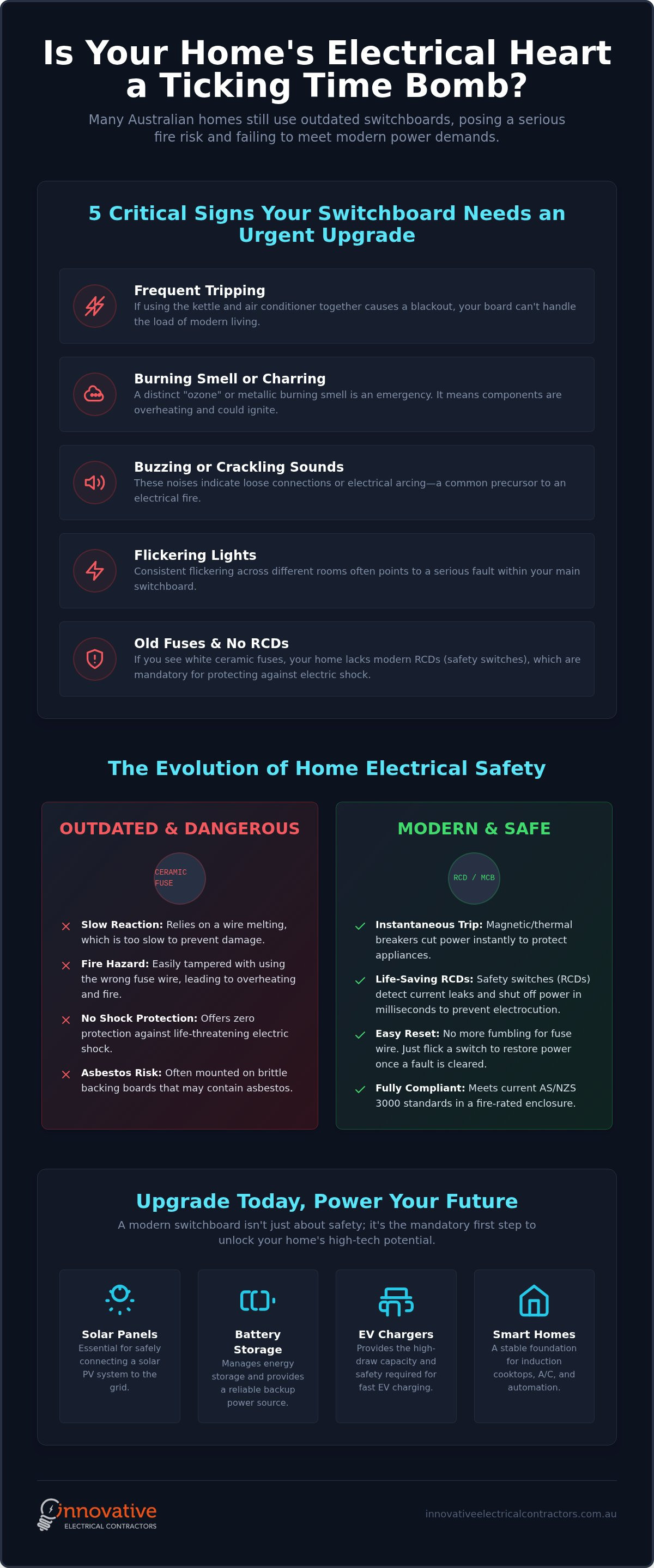
Old ceramic fuses are a relic of the past. They rely on a thin piece of wire that melts when too much current flows through it. These "re-wirable" fuses are no longer compliant in new installations because they're slow to react and easily tampered with. If someone uses the wrong gauge of fuse wire, the circuit won't trip when it should. This leads to charred cables and potential fires that can smoulder undetected for hours.
Modern circuit breakers are far more reliable. They use a magnetic or thermal mechanism to trip instantly when a fault is detected. Unlike fuses, they can be reset with a simple flick of a switch once the fault is cleared. This eliminates the need to fumble with fuse wire in the dark. An RCD is a life-saving device that monitors the flow of electricity and cuts power in milliseconds if it detects a leak to earth.
Five Warning Signs Your Switchboard is a Safety Risk
Identifying a failing system early can prevent catastrophic failure. Your home often provides subtle clues before a major fault occurs. If you notice any of these signs, an electrical switchboard upgrade should be your top priority to protect your family and property.
Frequent Tripping: Modern appliances draw significant current. If your circuits cut out every time you use the kettle and the clothes dryer together, your board is struggling to cope with the load.
The "Ozone" Smell: A distinct, metallic burning smell or visible charring on the panel is a critical emergency. This indicates that components are overheating and could ignite at any moment.
Strange Noises: Buzzing or crackling sounds from behind the panel often mean loose connections or arcing, which are common fire starters.
Flickering Lights: While often blamed on the bulb, consistent flickering across different rooms usually points to a fault in the main distribution board.
Missing Safety Switches: Under AS/NZS 3000:2018, RCDs are mandatory on all circuits. If your board only has old-fashioned fuses or lacks a "Test" button, it's non-compliant and dangerous.
Visual Red Flags Every Homeowner Should Know
Take a quick look inside your meter box. If you see white ceramic blocks with wire wrapped around them, you have an outdated fuse system. These lack the precision of modern breakers. You might also see "spaghetti wiring," where cables are tangled and crowded. This mess makes it difficult for heat to dissipate and complicates any future repairs. For those with external boards, check for rust or water ingress. Weatherproofing seals often fail over time, allowing moisture to corrode vital connections. If things look messy or outdated, it's worth asking a professional for expert electrical services to assess the risk.
The Hidden Danger of Asbestos Backing
Many Australian homes built before 1990 used black bituminous or zelemite backing boards that contain asbestos. These panels are safe if left alone, but they become extremely hazardous if drilled, cracked, or disturbed. Homeowners attempting DIY repairs often unknowingly release dangerous fibres into the air. Professional contractors are trained to identify these materials. We use specific safety protocols to manage and dispose of hazardous panels during an electrical switchboard upgrade, ensuring your home remains a clean and safe environment for your family.
Future-Proofing: Upgrading for Solar, Batteries, and EVs
The Australian energy landscape is shifting rapidly as we move toward a cleaner, more efficient future. Most residential properties built decades ago were designed for a simple, one-way flow of electricity from the grid to your appliances. Today, over 460,000 solar batteries have been installed across Australia since July 2025, and record numbers of homeowners are generating their own power. A standard 40-year-old board simply cannot manage the bi-directional flow of energy required for modern solar systems. Without an electrical switchboard upgrade, you risk overloading your system or being unable to connect new renewable technology at all.
Electric vehicles (EVs) are another major driver for modernisation. Installing a Level 2 home charger is like adding a second air conditioner to your home's total load. Under AS/NZS 3000:2018 Amendment 3 (2024), these chargers require dedicated circuits with individual RCDs. A cramped, outdated board won't have the physical space or the electrical capacity to support this demand. Modern enclosures are designed to integrate smart meters and advanced monitoring tools, giving you real-time data on how your home consumes and generates power.
Foundational Infrastructure for Renewable Energy
Success with solar and battery storage starts at the meter box. You need dedicated solar breakers and space for consumption monitoring hardware to ensure your system operates at peak efficiency. If you're considering battery storage, your board must be capable of handling "island mode" to provide backup power during grid outages. This setup complies with AS/NZS 5139:2019 and ensures your home remains functional when the neighbourhood goes dark. Beyond the immediate technical benefits, a modernised board significantly increases property value. If you are looking to capitalise on these upgrades, you might want to sell my home no commission australia to maximise your return. Future buyers are specifically looking for homes that are already "solar ready" and capable of supporting a sustainable lifestyle.
Many Australians are choosing to swap gas hot water systems and cooktops for high-efficiency electric alternatives. Induction cooktops, while incredibly fast and safe, require a robust electrical supply that old fuse boxes can't provide. In some cases, this transition might even require a move to 3-phase power to balance the load across your property. This is particularly common for homes with large solar arrays, multiple air conditioners, and EV chargers running simultaneously. An electrical switchboard upgrade is the first step in any home electrification project.
The Upgrade Process: What to Expect from Your Electrician
A professional electrical switchboard upgrade is a methodical process that prioritises safety and precision. It doesn't begin with a screwdriver; it begins with a comprehensive site audit. We perform a detailed load calculation to ensure your new board can handle your current appliances and future additions like EV chargers or solar batteries. This planning phase ensures we install the right capacity from day one.
Preparation is key for the day of installation. You'll need to plan for a scheduled power outage, typically lasting between four to eight hours. We coordinate directly with your energy distributor to manage the meter isolation and any necessary service fuse upgrades. While being without power is a temporary inconvenience, it's a necessary step to ensure the work is carried out in a safe, controlled environment.
Step-by-Step Installation Walkthrough
Once the power is isolated, we remove the old components and any hazardous backing materials. We then install a modern, fire-rated enclosure. A critical part of this stage is rewiring the neutral link and earthing system to meet current AS/NZS 3000 standards. These foundations are often neglected in older homes but are vital for the proper operation of safety switches.
Precision matters in the final assembly. We carefully organise and label every circuit, providing you with a clear map of your home's electrical layout. This makes future maintenance simple and safe. Before we leave, we conduct rigorous testing and commissioning. We verify the trip times of every RCD and ensure the entire system is fault-free. Our team takes pride in leaving your home exactly as we found it, minus the electrical risks. If you're ready to secure your home's future, book your switchboard audit today to get started.
Compliance and the Paperwork Trail
The job isn't finished until the legal requirements are met. We issue a Certificate of Electrical Safety (CES) upon completion. This document is your proof that the work complies with Australian regulations. You'll need this for insurance purposes and property valuations. We also handle the notification to your energy distributor regarding any meter changes or capacity increases. In some Australian jurisdictions, an independent inspector may be required to verify the installation, providing an extra layer of peace of mind for your investment.
Choosing a Professional Electrical Contractor for Your Upgrade
Selecting the right expert for an electrical switchboard upgrade is a decision that impacts your home's safety for decades. This is high-risk technical work that requires more than just basic electrical knowledge. You need a partner who prioritises precision and understands the complexities of the modern Australian grid. For families who value dedicated support and high standards of care, such as those provided by Im with you in the NDIS sector, finding a trustworthy professional is key to maintaining a safe home environment. Start by verifying that your contractor holds a valid electrical licence and comprehensive public liability insurance. These are non-negotiable requirements that protect you if something goes wrong during the installation.
Experience with modern technology is equally vital. As we've discussed, today's homes are becoming smart energy hubs. If you plan on installing solar or batteries, your electrician must understand bi-directional energy flow and the specific requirements of AS/NZS 5139. A "can-do" approach is essential, especially in older Australian homes where unexpected challenges like crumbling conduits or legacy wiring often emerge. Look for transparency in their quoting process. A professional will provide a detailed breakdown of components and labour rather than a vague ballpark figure.
It's tempting to choose the cheapest quote, but this often leads to the use of inferior components. Premium circuit breakers and RCDs are engineered to react faster and last longer, often providing reliable service for 25 years or more. Cheap alternatives may fail prematurely or, worse, fail to trip during a genuine fault. At Innovative Electrical Contractors, we focus on high-quality materials and methodical installation techniques. We believe a switchboard shouldn't just meet the minimum standard; it should exceed it to provide total peace of mind for your family.
Questions to Ask Your Sparky Before They Start
Before you sign a contract, ask specific questions to gauge their commitment to safety. A critical inquiry is: "Are you installing RCDs on every single circuit, including the oven and air conditioner?" Under current regulations, this is mandatory, but some installers might cut corners. You should also ask how they handle the discovery of asbestos or faulty existing wiring behind the panel. A prepared professional will have a clear protocol for managing these risks safely and legally. For a comprehensive review of your home's current capacity, contact Innovative Electrical Contractors for a professional assessment and ensure your home is ready for the future.
Secure Your Home’s Electrical Future Today
Your switchboard is the foundation of your modern lifestyle. Whether you're tired of frequent circuit trips or you're planning to join the thousands of Australians investing in renewable energy, an electrical switchboard upgrade is the most effective way to protect your property. Modernising your system ensures you comply with current AS/NZS 3000 standards while providing the capacity needed for EV chargers and battery storage. It transforms a hidden fire risk into a high-performance hub for your home.
Choosing the right partner makes all the difference for your peace of mind. Innovative Electrical Contractors are fully licensed and insured national contractors who specialise in expert solar and battery integration. We prioritise precision and safety in every project, ensuring your installation meets the highest industry benchmarks. Don't leave your family's safety to chance with outdated fuses and brittle wiring. Book your professional switchboard safety audit with Innovative Electrical Contractors today and take the first step toward a safer, all-electric home. We're ready to help you power your future with total confidence.
Frequently Asked Questions
How long does a switchboard upgrade actually take?
A standard electrical switchboard upgrade usually takes between four to eight hours to complete. The exact duration depends on the complexity of your home's wiring and whether we need to relocate the board. We aim to minimise disruption by planning the work meticulously. If we encounter issues like faulty existing circuits or a need for a new mains cable, the process might take a full day to finish safely.
Will my power be turned off during the upgrade process?
Yes, your power must be turned off for the duration of the installation. This is a non-negotiable safety requirement to protect our electricians while they remove old components and install the new fire-rated enclosure. We coordinate with your energy distributor to manage the isolation of the mains power. You should plan ahead by making arrangements for working from home or managing refrigerated goods during this scheduled downtime.
Is an electrical switchboard upgrade a legal requirement in Australia?
An upgrade isn't strictly mandatory for older homes that remain unchanged; however, it becomes a legal requirement during any major renovation or when adding new circuits. Under AS/NZS 3000:2018, any modification to your electrical system requires the installation of RCDs on all affected circuits. If your current board is deemed a fire hazard during a professional inspection, you have a duty of care to rectify it to ensure your property remains compliant.
Can I just replace a single fuse with a circuit breaker?
While you can sometimes fit a plug-in circuit breaker into an old fuse base, it's a temporary fix that doesn't provide full protection. These devices don't offer the life-saving residual current protection required by modern standards. A comprehensive electrical switchboard upgrade replaces the entire outdated assembly with a compliant board. This ensures every circuit in your home is protected by both a circuit breaker and a dedicated safety switch for maximum security.
How much does a typical switchboard upgrade cost?
Industry data suggests a standard electrical switchboard upgrade in Australia typically costs between A$900 and A$2,000. This range covers the materials and labour for a basic residential board replacement. The final price varies based on the number of circuits, the need for a 3-phase power upgrade, or the safe removal of asbestos backing. We provide detailed, transparent quotes so you understand exactly what is required for your specific property before work begins.
Do I need to upgrade my switchboard if I am installing solar panels?
Yes, installing solar panels almost always necessitates a switchboard upgrade. Modern solar systems require dedicated breakers and space for consumption monitoring that old fuse boxes simply don't have. Your board must also be capable of managing the bi-directional flow of electricity between your home and the grid. This ensures your renewable energy investment operates safely and complies with the latest Australian wiring rules for grid-connected systems and battery storage.
What is the difference between a safety switch and a circuit breaker?
A circuit breaker is designed to protect your home's wiring and appliances from overloads and short circuits. In contrast, a safety switch, or RCD, is designed to protect people from electric shock. It monitors the flow of current and cuts the power in milliseconds if it detects a leak to earth. Modern switchboards use combination devices that perform both roles, ensuring total protection for both your property and your family at all times.
What happens if my electrician finds asbestos behind the old board?
If asbestos backing is found, it must be managed according to strict safety protocols. Many Australian homes built before 1990 used zelemite or bituminous boards containing asbestos fibres. Our team is trained to identify these materials and arrange for safe removal and disposal. We never drill into or disturb these panels without the correct protective equipment. This ensures your home remains a safe environment for your family during and after the upgrade process.


Comments