
Daikin Air Conditioning: The Ultimate Australian Reference Guide 2026

Did you know that Daikin has been voted Australia's most trusted air conditioning brand for four consecutive years? It's a significant achievement, yet many homeowners still feel a bit stumped when they start digging into the technical specs. You've likely heard that daikin air conditioning is the gold standard for our harsh climate, but you might be worried about the higher upfront cost or feeling confused by the difference between the Alira X and the now-discontinued US7. It's completely normal to feel a bit of "analysis paralysis" when you're trying to avoid the expensive mistake of choosing an undersized unit for your property.
We believe you deserve total peace of mind and a home that stays perfectly comfortable without sending your energy bills through the roof. This guide simplifies the latest 2026 technology, from Streamer air purification to the efficiency of R32 refrigerant. We'll help you understand the current range so you can select a system with absolute confidence. You'll learn how to integrate these units with solar power, understand the new Zoned Energy Rating Labels, and find the exact model that fits your lifestyle and your building layout.
Table of Contents
Why Daikin Leads the Australian Air Conditioning Market in 2026
Daikin has spent over five decades refining its technology to suit the unique demands of our environment. While many competitors simply import generic models, Daikin Australia operates local manufacturing facilities within the country. This commitment ensures that every daikin air conditioning unit is built to handle everything from the dry heat of the outback to the humid coastal fringes. Understanding Daikin's history and global operations helps you appreciate their scale, but it's their local engineering and manufacturing footprint that truly sets them apart for Australian homeowners.
For families managing health concerns, Daikin remains the only brand with its entire split system range approved by the National Asthma Council Australia’s Sensitive Choice program. This is a direct result of their advanced filtration systems which effectively remove allergens, mould, and pollutants from your indoor air. It provides a level of reassurance that budget brands simply cannot match, particularly for those living with asthma or hay fever.
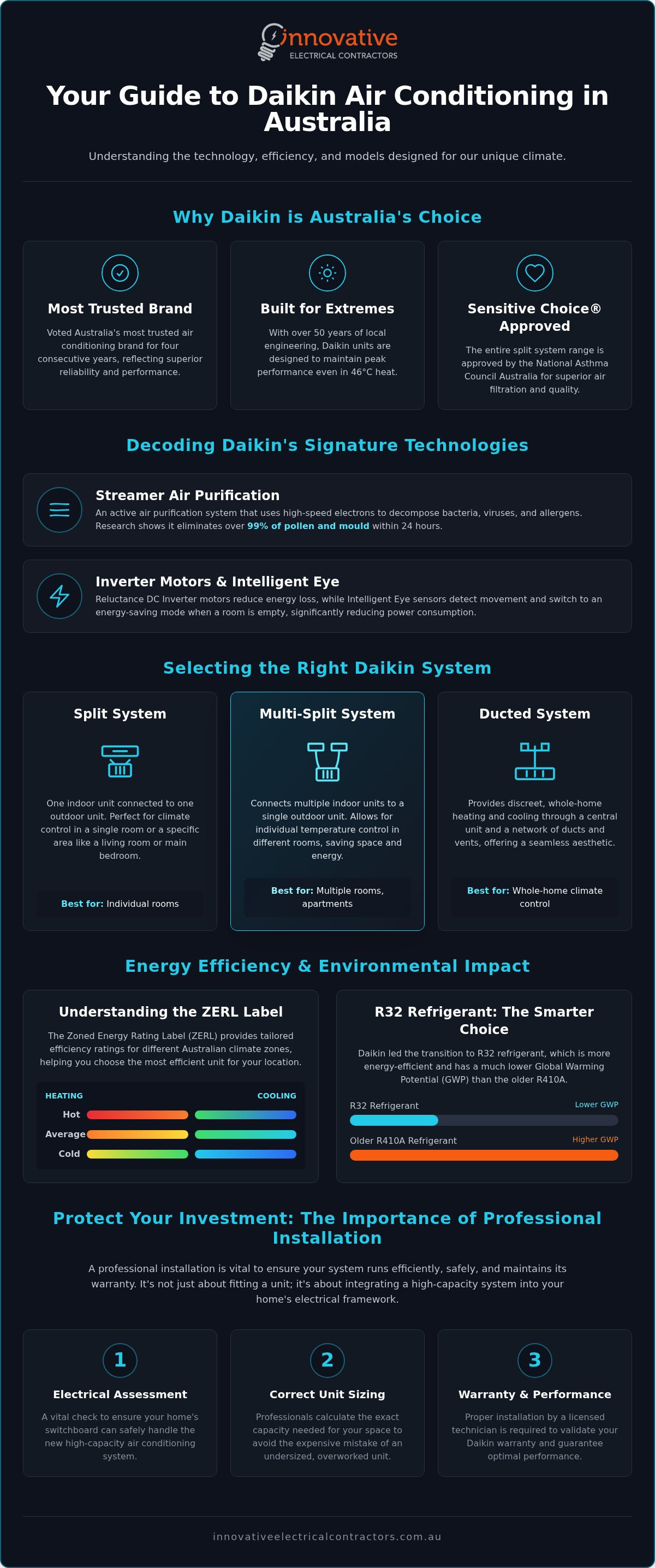
Reliability is where the brand earns its keep. Budget imports often struggle or shut down entirely when temperatures climb past 40°C. Daikin systems are designed to maintain peak performance even in 46°C extremes. They also led the industry transition to R32 refrigerant. This move offers a lower Global Warming Potential (GWP) than older R410A units, making your home more sustainable without sacrificing cooling power or efficiency. It's a forward-thinking approach that prioritises both the environment and long-term performance.
The "Reverse Cycle" Advantage for Australian Seasons
In Australia, we don't just need cooling; our winters can be surprisingly biting. Reverse cycle technology is essentially a heat pump that moves heat into or out of your home. It's far more efficient than traditional electric heaters, which often consume significant power to produce minimal warmth. By choosing a single system for year-round climate control, you reduce maintenance costs and simplify your home's electrical services requirements. One unit does it all, keeping you warm in July and cool in January.
Built for the Extreme: Daikin’s Durability Standards
Living near the coast is beautiful, but salt air is brutal on machinery. Daikin's Blue Fin technology provides a special anti-corrosion coating on the outdoor heat exchanger, extending the life of your daikin air conditioning investment. This durability is backed by a robust local network. Because they have a significant Australian presence, sourcing spare parts or technical support is straightforward. You aren't waiting for a shipment from overseas; help is usually just a phone call away from a licensed technician who understands our local conditions and building standards.
Decoding Daikin Signature Technologies: Streamer, US7, and Inverters
Investing in a daikin air conditioning system means you're buying more than just a fan and a compressor. You're securing a suite of patented technologies designed for precision. One of the most significant features is Streamer Technology. This isn't a standard filter; it's an active air purification system. It uses a high-speed electron discharge to break down bacteria, viruses, and allergens. In fact, research shows it eliminates over 99% of pollen and mould within 24 hours, making it a vital tool for maintaining a healthy indoor environment.
While the Ururu Sarara (US7) has set the benchmark as a high-efficiency system capable of humidifying and ventilating without a water tank, other models now carry that legacy of innovation. Daikin's Reluctance DC Inverter motors use powerful neodymium magnets to drive the compressor. This design significantly reduces energy loss compared to standard induction motors. When you pair this with Intelligent Eye sensors, which detect movement and pivot the unit into an energy-saving mode when the room is empty, the efficiency gains are substantial. By following energy efficiency guidance from the Australian Government, you can maximise the savings these sensors provide.
Air Quality and Purification: Beyond Simple Cooling
Modern indoor air quality (IAQ) is about more than just temperature. Daikin units often feature titanium apatite deodorising filters that trap microscopic particles and decompose odours. This multi-layered approach ensures the air you breathe is as crisp as the temperature feels. As homes become more airtight to meet energy standards, these purification systems prevent the buildup of stale air and indoor pollutants.
Precision Inverter Control for Consistent Comfort
Inverter technology is a method of modulating power to maintain a steady temperature without constant restarts. Unlike old-fashioned "On/Off" systems that blast cold air and then shut down, Daikin's variable speed inverters gently adjust their output. This prevents the "cold draft" effect and keeps the room within a fraction of a degree of your target. Their 3D airflow system further enhances this by circulating air vertically and horizontally, ensuring every corner of the room reaches the desired temperature. If you're building a new home, getting professional electrical advice early ensures your tech works exactly as intended.
Selecting the Right Daikin System: Split, Multi-Split, or Ducted?
Choosing a daikin air conditioning system isn't just about picking a brand; it's about matching the technology to your specific floor plan. A small apartment requires a completely different approach than a sprawling two-storey home. You need to consider where the units will sit on your walls, the available ceiling cavity, and how much space you have outside for the condenser unit. Getting this right ensures you don't end up with an undersized system that works too hard or an oversized one that wastes energy.
If you need to cool three or four rooms but don't have the outdoor space for multiple condensers, a multi-split system is the answer. One outdoor unit powers several indoor units, which can be a mix of wall-mounted or floor-standing models. This setup gives you independent control over each room's temperature. It's a smart way to manage your home's daikin air conditioning needs without cluttering your garden or balcony with bulky machinery.
The Residential Range: Cora, Alira X, and Lite
For single rooms or open-plan living areas, split systems are the most popular choice. The Cora series is often favoured for bedrooms because it's incredibly quiet and features a subtle, curved design. If you're looking for the highest efficiency and built-in Wi-Fi as standard, the Alira X is the premium choice. It was updated in July 2026 with enhanced heating features for those cold winter mornings. For those seeking the reliability of Daikin without the extra bells and whistles, the Lite or Sensira models provide a solid entry point into the range.
Ducted Solutions for Larger Properties
Ducted systems are the ultimate for aesthetics and whole-home comfort. The components are hidden in your ceiling, with only sleek vents visible in each room. Daikin offers both Premium and Standard Inverter ranges. The Premium models are particularly effective at maintaining efficiency during high-load periods. One of the biggest advantages is zoning. You can easily cool the living areas during the day and switch to the bedrooms at night. This ensures you aren't wasting energy on empty spaces. It's a seamless integration that works perfectly with new home builds where climate control can be designed into the architecture from the start.
Before deciding, look at your property's constraints. Ducted systems require significant ceiling space for the indoor unit and ducting. If you have a flat roof or limited crawl space, a multi-split might be your only option. Wall-mounted split units need clear "real estate" on an internal wall that allows for tidy pipe runs to the outside. A licensed professional can help you map out these logistics to ensure your system operates at peak performance.
Energy Efficiency and Running Costs: The Daikin Advantage
Understanding the Zoned Energy Rating Label (ZERL) is essential for any Australian homeowner. This label doesn't just give a generic star rating; it breaks down performance across hot, average, and cold zones. Because daikin air conditioning systems are engineered for local conditions, they often achieve higher ratings in the zones where you need them most. These stars aren't just for show. They represent a tangible reduction in your quarterly electricity bills by ensuring the compressor only uses the exact amount of energy required to maintain your comfort.
If you've invested in a solar battery installation, your AC becomes even more cost-effective. By pairing a high-efficiency Daikin unit with solar power, you can effectively run your climate control for free during daylight hours. Modern units also feature "Econo Mode," which limits the maximum power consumption. This is particularly useful when you're running multiple appliances at once and want to avoid exceeding your solar inverter's capacity. Conversely, "Power Chill" mode provides a quick burst of cooling when you first get home, before settling back into an energy-saving rhythm.
Calculating Your Potential ROI
While a high-efficiency 7-star unit may have a higher initial price point, it typically pays for itself within three to five years through reduced running costs. Daikin's 2026 models have also made significant strides in reducing standby power consumption. This "vampire" energy often goes unnoticed, but modern circuitry ensures the unit draws almost nothing when not in use. Professional sizing is the final piece of the puzzle. An undersized unit will run constantly at maximum capacity, wearing out parts and wasting power. We can help you calculate the perfect capacity for your specific room volume to ensure peak efficiency.
Smart Control: Daikin Mobile Controller and D-Mobile
The D-Mobile app transforms how you manage energy. You can schedule your cooling to start exactly when your solar panels are producing peak power, effectively "pre-cooling" your home with renewable energy. Remote monitoring also provides peace of mind. If you've rushed out the door and forgotten to turn the air off, a quick check on your smartphone allows you to shut it down from anywhere. These systems integrate seamlessly with Google Home and Amazon Alexa, allowing for voice-controlled adjustments that keep your home efficient without you lifting a finger.
Professional Installation and Maintenance: Protecting Your Investment
Selecting the right daikin air conditioning system is only half the battle. The quality of the installation determines whether that unit lives up to its energy star rating or becomes a constant source of frustration. A licensed electrical contractor brings more than just tools to the job; they bring an understanding of Australian standards and safety protocols. Daikin provides a robust 5-year parts and labour warranty on their residential range, but this protection is strictly conditional. If your system isn't installed by a qualified professional, you risk voiding that warranty entirely before you've even turned the unit on.
The "Switchboard Factor" is a common hurdle in many Australian homes. Modern, high-capacity climate control systems draw significant power, especially during the initial "Power Chill" phase. If your home's electrical services are outdated, adding a new AC unit could lead to frequent circuit trips or even fire risks from overloaded wiring. We often find that a switchboard upgrade is a necessary part of the installation process to ensure your home remains safe and your new system operates at peak performance. Skipping this step with a "backyard" installer might save money upfront, but the long-term risks to your property are substantial.
The Installation Process: What to Expect
A professional installation begins with a thorough site assessment. We don't just look at the room size; we calculate the thermal load based on window orientation, ceiling height, and insulation quality. This ensures your daikin air conditioning is sized perfectly for the space. Once the physical units are in place, the electrical infrastructure is tested. The final stage is commissioning. This involves pressure testing the pipework and verifying the refrigerant charge. These technical steps are vital for preventing gas leaks that can cripple your system's efficiency and damage the environment.
Routine Maintenance for Longevity
You play a vital role in the DIY part of maintenance. We recommend cleaning your indoor unit filters every few months to maintain airflow and air quality. However, a professional service once a year is essential for the technical components. During these checks, we inspect gas levels, clear drainage lines, and tighten electrical connections that may have loosened due to vibration. This proactive approach prevents small issues from turning into expensive repairs and ensures your system continues to deliver the lowest possible energy bills. Ready to upgrade your comfort? Contact Innovative Electrical Contractors for a professional Daikin installation quote.
Future-Proof Your Home with Smarter Climate Control
Choosing the right daikin air conditioning system is an investment in your property's value and your family's daily comfort. We've explored how Daikin’s local engineering and advanced Streamer technology provide a level of air purity and reliability that budget brands simply can't match. Whether you opt for a sleek Cora split system or a whole-home ducted solution, the key to long-term satisfaction lies in precision sizing and professional electrical integration. By pairing these high-efficiency units with modern solar and battery systems, you can enjoy a perfectly controlled climate while keeping your energy bills to an absolute minimum.
As licensed Australian electrical contractors, we specialise in the complex integration of solar and air conditioning to ensure your home’s infrastructure is safe and efficient. Don't leave your comfort to chance with an unlicensed installation that could void your warranty or risk your safety. Our team provides expert national support to help you navigate the technical specs and find the ideal setup for your specific needs. It's time to enjoy the peace of mind that comes with a masterfully installed system.
Get a Professional Daikin Quote from Innovative Electrical Contractors and start your journey toward a cooler, more efficient home today.
Frequently Asked Questions
Is Daikin better than Mitsubishi Electric for Australian homes?
Both brands offer exceptional performance, but Daikin’s specific advantage lies in its extensive local engineering and manufacturing footprint within Australia. This means their units are purpose-built for our unique climate extremes rather than being generic global models. Additionally, Daikin is the only brand with its entire range of split systems approved by the National Asthma Council Australia’s Sensitive Choice program, providing extra reassurance for families with respiratory sensitivities.
How much does it cost to run a Daikin ducted system per hour?
Running costs vary based on your local electricity rates, insulation levels, and climate zone. While exact figures are difficult to pinpoint, Daikin’s advanced inverter technology is designed to operate significantly more efficiently than older fixed-speed units. By using zoning controls in a ducted system, you can further reduce costs by only conditioning the rooms you are currently using, ensuring you aren't paying for cooling in empty spaces.
What is the "Intelligent Eye" feature on Daikin split systems?
The Intelligent Eye is a sophisticated infrared sensor that detects movement within a room. If the space is left empty for 20 minutes, the daikin air conditioning system automatically shifts into an energy-saving mode to reduce power consumption. Once you return, the unit resumes its previous settings. It can also be programmed to adjust the direction of airflow away from occupants to prevent direct drafts and increase personal comfort.
Does Daikin offer a warranty on their air conditioners?
Daikin provides a 5-year parts and labour warranty for their residential systems, covering split, multi-split, and ducted models. This guarantee ensures that any manufacturing faults are addressed without out-of-pocket expenses during the first five years of ownership. To maintain this protection, the system must be installed by a licensed professional. Always keep your compliance certificates and invoices safe, as they are required for any future warranty claims or service history.
Can I install a Daikin air conditioner myself to save money?
You cannot install a split or ducted system yourself in Australia. It is a legal requirement that all air conditioning work involving refrigerants and high-voltage wiring be performed by licensed professionals. A DIY attempt not only risks your physical safety and property but will also immediately void your 5-year manufacturer warranty. Professional installation ensures the system is pressure-tested and commissioned correctly for maximum efficiency and long-term reliability.
What size Daikin air conditioner do I need for a 20sqm bedroom?
A typical 20sqm bedroom generally requires a unit with a capacity of approximately 2.5kW. However, we also evaluate the room's orientation, window size, and insulation quality before making a final recommendation. Choosing the correct capacity is vital; an undersized unit will run constantly and wear out faster, while an oversized unit will cycle on and off too frequently. We ensure your daikin air conditioning is perfectly matched to your specific room volume.
How often should I have my Daikin air conditioner serviced?
We recommend a professional service at least once a year to keep your system in peak condition. An annual check allows a technician to inspect gas pressures, clear drainage lines, and verify that all electrical connections remain secure. Between these visits, you should clean the indoor unit filters every few months. Regular maintenance prevents minor issues from becoming major breakdowns and ensures your system continues to operate at the highest possible efficiency.
Are Daikin air conditioners compatible with solar power systems?
Modern Daikin units are highly compatible with solar and battery systems due to their inverter technology, which avoids the massive power spikes associated with older compressors. By integrating your AC with a solar setup, you can schedule the system to run during peak sunlight hours to pre-cool your home using renewable energy. This synergy between solar production and high-efficiency climate control is one of the best ways to achieve a carbon-neutral home environment.


Comments