
Instant asset write-off for commercial solar costs and eligibility
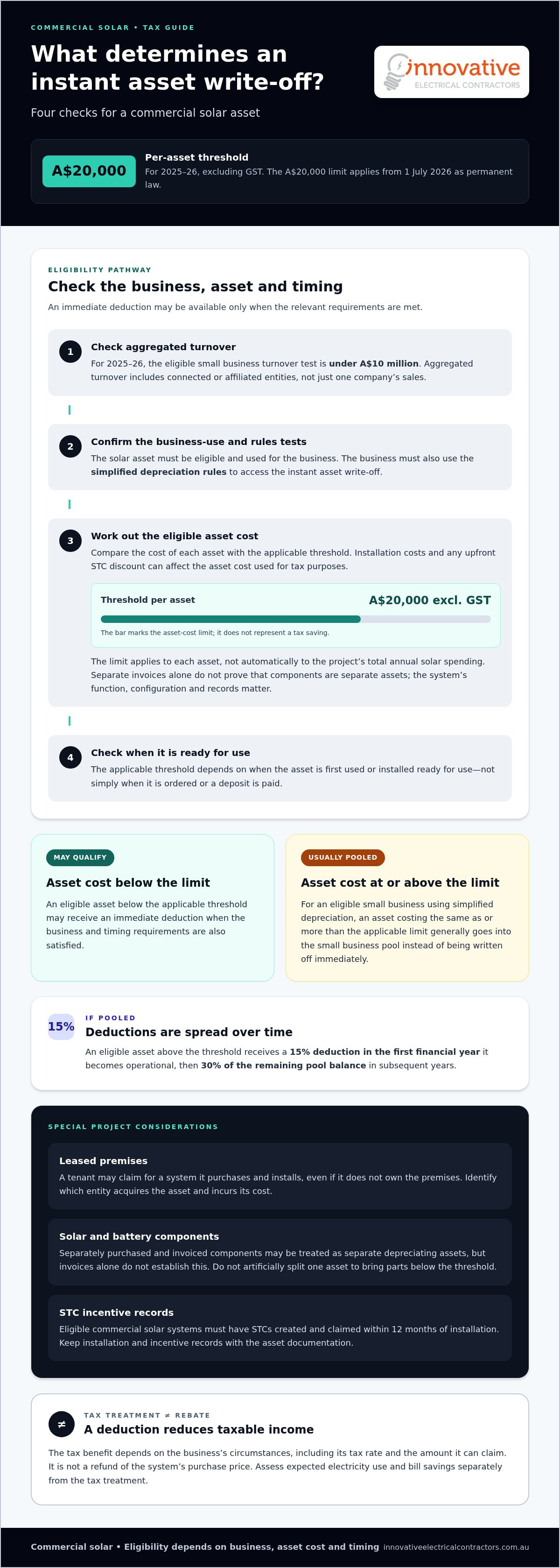
A commercial solar system isn’t automatically written off just because a business installs it. Eligible small businesses with aggregated turnover under A$10 million may immediately deduct eligible assets costing up to A$20,000 per asset, excluding GST; the Australian Taxation Office confirmed the A$20,000 limit applies from 1 July 2026 as permanent law. That’s the key rule behind the instant asset write-off for commercial solar systems, but the asset’s cost and when it’s ready for use also matter.
It’s easy to assume a tax write-off covers the full system price like a rebate. It doesn’t: a deduction reduces taxable income, so its value depends on the business’s circumstances. Understanding the difference helps you assess the likely tax benefit before committing to a commercial solar project.
This article explains how eligibility works, which project costs count and why installation timing matters. It also covers how the write-off may affect your tax bill, what happens when a system exceeds the threshold, and how solar and battery installation can fit into a business energy plan.
Table of Contents
Can solar systems be written off under the Instant Asset Write-Off?
Eligible Australian small businesses may immediately deduct qualifying solar assets if they meet the turnover, asset-cost and business-use requirements. The deduction reduces taxable income; it isn’t a rebate against the system’s purchase price.
Small business turnover eligibility
For this rule, small business eligibility depends on the business’s aggregated turnover, which must be under A$10 million for the 2025–26 financial year. Aggregated turnover considers the business alongside connected or affiliated entities, so reviewing only one company’s sales may give an incomplete picture. The Australian Taxation Office says eligible small businesses can immediately deduct eligible assets costing up to A$20,000 per asset, excluding GST, in that financial year.
The threshold applies to each asset, not automatically to a business’s total annual solar spending. If you’re considering separate systems, assess whether each is a distinct asset and whether its cost falls below the limit. The business must also use the simplified depreciation rules to access the instant asset write-off. An accountant can help assess turnover, asset treatment and the necessary tax records.
Solar systems in leased premises
A tenant may claim for a solar system it purchases and installs, even if it doesn’t own the premises. This can matter for a business leasing a warehouse, workshop or office: ownership of the roof and ownership of the solar asset aren’t necessarily the same. Identify who purchases and installs the system before deciding which entity may claim the deduction.
Can a business claim the instant asset write-off for a financed or leased solar system? Financing alone doesn’t establish eligibility; the business still needs to meet the scheme’s criteria. A tenant that purchases and installs the system may claim, while a lease arrangement requires careful attention to who acquires the asset and incurs its cost.
Commercial solar tax benefits
An immediate deduction may bring a qualifying asset’s tax deduction forward instead of spreading depreciation over its effective life. Its value depends on the business’s taxable income and tax rate, so the deduction isn’t the same as getting the system cost back. Assess expected electricity use and bill savings separately from the tax treatment.
For example, compare the system’s expected contribution to daytime electricity demand with its eligible cost and likely tax effect. Involve an accountant before signing a contract, especially if ownership, business use or asset separation could affect the claim. This helps clarify both operating benefits and tax timing.
Solar incentives also involve separate eligibility and deadlines. According to the Clean Energy Regulator, eligible commercial solar systems must have their STCs created and claimed within 12 months of installation. An upfront STC discount can affect the amount paid for the solar asset and its tax-deductible valuation. Keep the installation and incentive records with the asset documentation so the tax calculation reflects the project accurately.
Assets costing the same as or more than the threshold
A solar asset at or above the applicable threshold generally can’t be deducted immediately under the instant asset write-off. For eligible small businesses using simplified depreciation, the alternative is usually to allocate the asset to the small business pool and claim deductions over time.
Thresholds across income years
The threshold is the maximum eligible asset cost for an immediate deduction in a particular income year. The applicable limit depends on when the asset is first used or installed ready for use, not simply when the business orders or pays for it.
For 2025–26, the threshold is A$20,000 per asset, excluding GST. The Australian Taxation Office confirmed on 27 August 2026 that the A$20,000 limit from 1 July 2026 is permanent law. Earlier limits differed: eligible assets first used or installed ready for use from 29 January 2019 to before 7:30 pm AEDT on 2 April 2019 had a A$25,000 limit. The limit became A$30,000 for the period from 7:30 pm AEDT on 2 April 2019 to 11 March 2020.
Applying the per-asset threshold
The limit applies to each eligible asset, not the business’s total annual purchases. This distinction matters when a project includes solar generation hardware and battery storage, as separately purchased and invoiced components may be treated as separate depreciating assets.
However, separate invoices alone don’t establish that components are separate assets. The system’s function, configuration and asset records matter too. An asset costing the same as or more than the applicable limit must go into the small business pool when the business uses simplified depreciation. Don’t artificially split one asset to bring its parts below the threshold.
How does the instant asset write-off compare with small business depreciation pooling for commercial solar? The write-off claims an eligible asset’s full deduction immediately. Pooling spreads deductions over time: an eligible asset above the threshold receives a 15% deduction in the first financial year it becomes operational, then 30% of the remaining pool balance in subsequent years.
For example, a qualifying solar asset costing more than A$20,000 doesn’t receive the full immediate deduction under the current threshold. Its deduction instead follows the pool calculation, reducing taxable income across financial years. The timing and amount claimed therefore differ, even though both methods provide depreciation deductions.
Keep the purchase and installation records clear, including separate asset descriptions where the project includes distinct equipment. If you’re planning commercial solar, commercial solar installation planning can help clarify the project scope before its tax treatment is assessed.
Asset installation and ready-for-use timing
For a commercial solar deduction, the relevant date is when the asset is first used or installed ready for use. The order date and deposit date don’t meet this timing test.
For the 2025–26 financial year, commercial solar hardware had to be installed and ready for use before 30 June 2026 to qualify in that year. That deadline has passed. A business assessing a claim for that financial year needs to establish when the system reached ready-for-use status, rather than relying on the date it approved a quote or paid an invoice.
“Ready for use” means the asset is installed and available to perform its intended business function. For a solar system, installation progress alone may not tell the whole story: panels or an inverter delivered to the site aren’t necessarily an operational asset. The system’s installation and commissioning status help distinguish equipment still being completed from equipment ready to generate energy for the business.
Keep dated records of the key project stages. The purchase invoice shows what the business acquired; installation records and commissioning documents help establish when the equipment was installed and ready. If components are invoiced or completed at different times, record each one’s status. This creates a clearer timeline when a solar project spans financial years.
How do GST, private use and taxable-purpose rules affect a commercial solar deduction? A GST-registered business entitled to a full GST credit excludes GST when calculating the asset’s depreciation cost. If the asset is used partly for private purposes, reduce the deductible amount by the private-use portion, and ensure the asset’s full cost is below the applicable limit. The deduction must also relate to business use that produces assessable income.
Timing and the business’s eligibility are separate tests. For the 2025–26 year, eligible small businesses had to meet the aggregated turnover limit of under A$10 million, as well as the asset and timing rules. A system installed after 30 June 2026 falls into a different financial year; its eligibility and applicable threshold must be assessed under the rules for that year.
That distinction matters for projects planned around year-end. A purchase made before 30 June doesn’t, by itself, secure a deduction in that financial year if installation is incomplete. Businesses should keep invoices, commissioning records and asset breakdowns together, then give their accountant the dates and business-use details needed to assess the claim.
Commercial solar system costs and write-off eligibility
Eligibility depends on the asset’s cost, business use and installation timing. Assessing each factor helps clarify which parts of a commercial solar investment may qualify.
Eligible commercial solar costs
The asset cost can include solar panels, inverters and installation work needed to put the system in place. Labour, racking and cabling are included in the asset’s cost base, so an equipment-only figure may not show the full amount assessed against the threshold.
An upfront STC discount affects what the business pays for the solar asset and its tax-deductible valuation. A GST-registered business entitled to a full GST credit excludes GST from the asset’s depreciation cost. Keep the invoice breakdown, discount details and GST records together for your accountant.
Eligibility checks and installation dates
Eligibility checks bring together the business’s aggregated turnover, asset cost, taxable business use and the date the system is first used or installed ready for use. An accountant can assess how these details apply to the relevant income year before the business claims a deduction.
For commercial rental premises, keep a clear record of who purchased and installed the system. A business tenant may claim for a system it purchases and installs, even if it doesn’t own the premises. A landlord should distinguish its own investment from equipment acquired and installed by the tenant.
The date matters too: ordering solar panels or paying a deposit doesn’t satisfy the ready-for-use test. Installation and commissioning records help establish when the system could serve its intended business purpose.
Records and tax return steps
To claim the deduction in an Australian tax return, retain the purchase invoice, commissioning certificates and asset breakdowns. Give these records, the installation date, business-use details and GST treatment to the accountant preparing the return.
Solar generation hardware and commercial battery storage may be treated as separate depreciating assets when purchased and invoiced separately. Clear invoices can help explain the asset breakdown and the calculation recorded in the business’s tax documents.
Claim risks and ATO review
A claim can be challenged if its cost, business use, asset treatment or ready-for-use date doesn’t match the supporting records. If the Australian Taxation Office reviews a claim, invoices, commissioning certificates and asset breakdowns can help explain how the business calculated the deduction.
Common errors include counting GST despite being entitled to a full credit, overlooking private use, or treating one asset as several without a sound basis. A deduction must also reflect the asset’s taxable business purpose. An accountant can assess these details against the eligibility rules and relevant financial year before lodgement.
Tax savings from the instant asset write-off
The main tax benefit is timing: an eligible business claims a deduction sooner rather than spreading it across depreciation years. This can lower taxable income in the year the asset qualifies. It isn’t a rebate, and the tax reduction depends on the business’s tax rate and taxable position.
Consider an eligible A$12,000 solar asset written off in the year it becomes operational. The deduction is A$12,000 against taxable income. The deduction and the resulting tax saving are different amounts.
The instant asset write-off for commercial solar systems can bring a deduction forward, but the business must assess eligibility alongside its expected return. For 2025–26, eligible small businesses must meet the aggregated turnover test and the asset-cost threshold. Business use and timing also affect whether the deduction applies in that income year.
Compare that timing with the asset’s effective life. Solar PV typically has a 10-year effective life under the Australian Taxation Office’s effective-life schedule. An asset above the threshold may enter the small business pool, where deductions are spread across financial years rather than claimed immediately.
System components can affect the calculation. Solar generation hardware and commercial batteries may be treated as separate depreciating assets when purchased and invoiced separately. This can affect which threshold applies to each asset. Assess invoices, asset breakdowns and any upfront STC discount before calculating the claim.
Business use matters too. If a system serves both business and private purposes, reduce the deductible amount by the private-use portion. A GST-registered business entitled to a full GST credit excludes GST when calculating depreciation cost. These adjustments can change the deduction even when the system’s headline price appears below the threshold.
When assessing the instant asset write-off for commercial solar systems, compare the tax effect with expected energy-bill savings and the system’s role in daily operations. Keep tax benefits separate from operating savings: panels may reduce purchased electricity, while the deduction affects taxable income. An accountant can assess both parts of the business case.
If you’re weighing a commercial solar project alongside its tax impact, plan your commercial solar installation around your business’s energy needs.
Innovative Electrical Contractors: Commercial Electrical
Innovative Electrical Contractors provides commercial electrical, solar and battery services for businesses planning a commercial solar project. Turn to the team when assessing a new installation, integrating battery storage or coordinating electrical work for a commercial site.
The right system depends on the site’s energy use, electrical requirements and project scope. Innovative Electrical Contractors can plan the electrical and solar work, while your accountant assesses tax eligibility, asset costs and the deduction. Keeping these roles clear helps you plan the installation and make the separate tax decision.
For businesses considering off-grid solar, batteries and generators, the project can also be planned around those power requirements. Contact Innovative Electrical Contractors to discuss your commercial electrical or solar project.
Plan the project with tax and energy goals in view
Bring your tax planning and site requirements into the same conversation. A clear project scope can help your accountant assess the asset treatment while the electrical plan reflects how your business uses power. Consider whether solar, batteries or off-grid generation suit the site and its operating needs.
Innovative Electrical Contractors provides Commercial Electrical, Electrical Services, and off-grid solar, battery and generator installations. The team can help shape the electrical project; your accountant can assess the tax position. Keeping those roles clear makes it easier to plan the installation without treating a possible deduction as the project’s only benefit.
Assess the instant asset write-off for commercial solar systems alongside your broader investment decision, including expected energy use and the system’s role in day-to-day operations. This helps you consider the project as both an electrical upgrade and a business decision.
Contact Innovative Electrical Contractors to discuss your commercial electrical or solar project and take the next step with confidence.
Frequently Asked Questions
What if I rent my business premises?
A tenant may claim for a solar system it purchases and installs, even if it doesn’t own the building. For example, a business leasing a warehouse could assess a system it buys for its operations. The lease arrangement matters because it can affect who acquires and uses the equipment. Keep purchase documents and installation records that identify the business claiming the asset.
Why invest in solar for business?
Solar can help a business generate electricity for its operations and reduce the amount it buys from the grid. The business case is strongest when electricity use aligns with solar generation, such as during daytime operations. Compare expected energy use, system output and any battery requirements alongside the tax treatment. A deduction may affect taxable income, but it doesn’t replace an assessment of operating needs and expected bill savings.
Are solar batteries deductible too?
A business battery may be deductible if it meets the relevant asset and business-use rules. If it costs below the applicable threshold, an eligible business may claim an immediate deduction; if it exceeds the limit, depreciation may apply instead. A battery bought and invoiced separately from solar generation hardware may be treated as a separate depreciating asset. Keep its invoice and asset description distinct for the tax assessment.
Can I claim multiple solar systems?
Eligible businesses may be able to assess multiple systems separately if each is an individual asset under the applicable threshold. For instance, systems at separate business sites may be assessed individually, but separate locations alone don’t establish separate assets. The equipment’s configuration, purchase documents and asset breakdown help determine the correct treatment. Keep records for each installation so its cost, business use and ready-for-use timing can be assessed clearly.
Can landlords claim the write-off?
Owning the premises doesn’t by itself establish who can claim for solar equipment. The relevant entity needs to acquire the asset and meet the business-use and other eligibility rules. If a tenant buys and installs the system, the tenant may be able to claim despite not owning the building. A landlord assessing equipment it purchases should distinguish its own asset and taxable use from any tenant-owned installation.
Does system size affect the depreciation calculation?
System capacity alone doesn’t determine the deduction; the asset’s eligible cost and applicable depreciation treatment matter. A larger array may cost more and exceed the immediate write-off threshold, leading to depreciation through the small business pool instead. Solar PV has a 10-year effective life under the Australian Taxation Office’s schedule, but simplified depreciation pooling can apply to eligible small businesses. The asset’s classification and cost guide the calculation.
Need help before the EOFY deadline?
Plan backwards from 30 June, allowing enough time for the system to be installed and ready for use in the relevant financial year. A signed quote, order or deposit doesn’t meet that timing test. Give your accountant the proposed project dates and asset details early, so the tax assessment can account for the installation stage. Keep commissioning and purchase records together to support the date used in the return.
What is Australia's instant asset write-off threshold for 2025–26?
For the 2025–26 financial year, eligible Australian small businesses can immediately deduct eligible assets costing up to A$20,000 per asset, excluding GST. Eligibility also depends on the business meeting the aggregated turnover test and using simplified depreciation rules. The asset must meet the relevant use and timing requirements. Assess each system’s cost separately, rather than assuming a project’s total spend determines every asset’s treatment.


Comments