
Outback Power vs Victron: Which Controller Fits Your Battery
The better choice in an Outback Power vs Victron off-grid charge controller comparison is the one that matches your solar array and battery bank, not simply the brand name. The Outback FM100 AFCI has a listed input voltage of 300 V and is compatible with 24 V, 36 V and 48 V battery systems. Your PV string voltage, battery compatibility and the way you want to monitor and connect the system should guide the decision.
It’s easy to focus on controller features and overlook how they work with the rest of an off-grid setup. But a mismatch between array voltage, battery voltage and system requirements can make an otherwise capable controller the wrong fit.
This comparison explains how to assess input voltage and battery compatibility, then weighs monitoring and networking needs. You’ll also find a practical decision guide to help narrow the choice for your off-grid system in Australia.
Table of Contents
Controller input voltage and battery compatibility
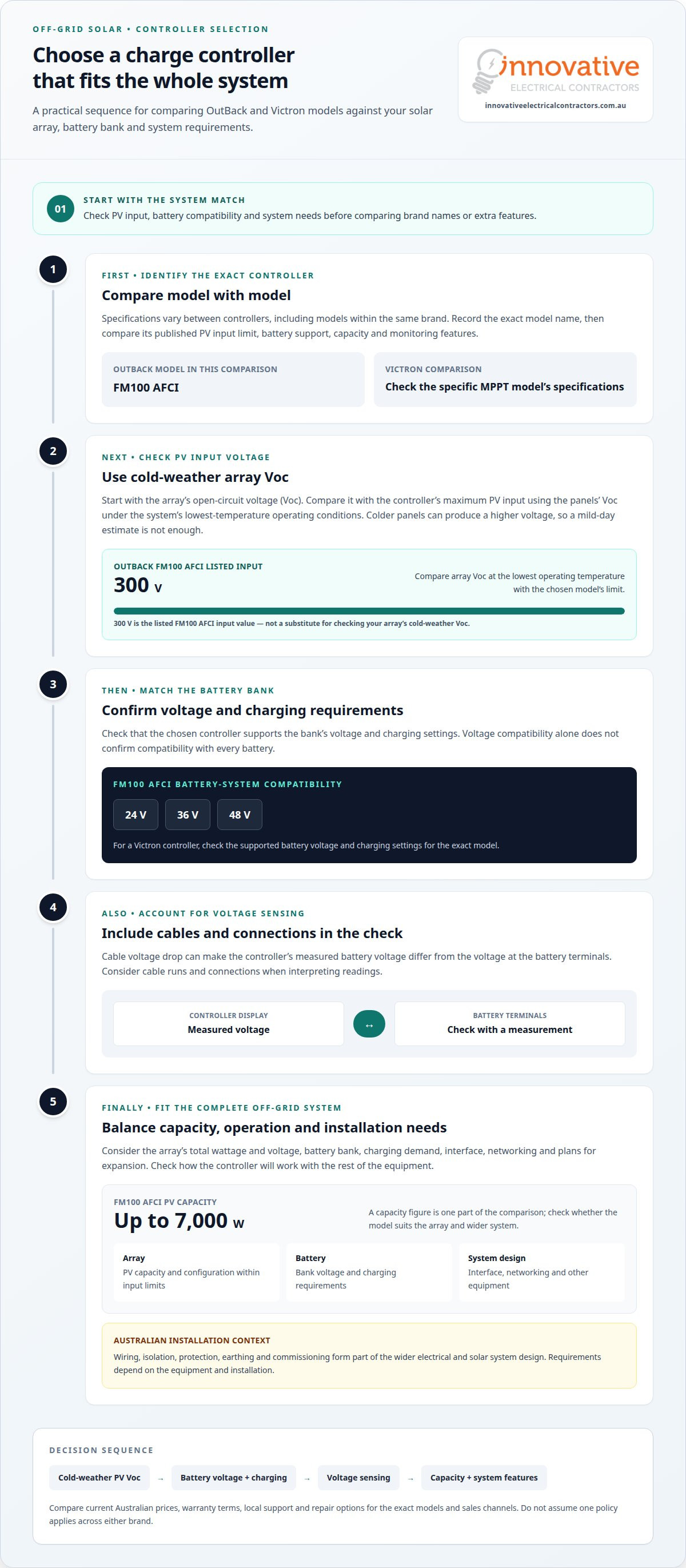
Start with the solar array’s open-circuit voltage, or Voc, then compare it with the controller’s maximum PV input voltage. Use the panels’ Voc under the system’s lowest-temperature operating conditions, because colder panels can produce a higher voltage. The array must stay within the controller’s limit in those conditions, not just on a warm day.
The OutBack FM100 AFCI has a listed input voltage of 300 V and supports 24 V, 36 V and 48 V battery systems. Those details can suit a higher-voltage PV string, but they don’t establish compatibility with every battery. Match the controller’s supported battery voltage and charging settings to the battery bank.
OutBack voltage-sensing accuracy matters because the controller uses battery voltage to guide charging. Voltage drop along the cable between the controller and battery can make the measured voltage differ from the voltage at the battery terminals. Include cable runs and connections in the system design, and compare the controller’s displayed reading with a measurement at the battery terminals.
Neither brand can be judged more reliable by name alone; installation conditions and correct system matching matter. When sourcing components through Innovative Electrical Contractors, compare current Australian prices for models with equivalent input capacity, battery compatibility and monitoring features, rather than comparing brand labels.
Warranty terms, local support and repair options depend on the specific model and sales channel. Compare the terms for the exact controller instead of assuming one policy applies across either brand.
First match cold-weather PV Voc, then battery voltage and charging requirements, followed by sensing and support needs.
Controller selection for off-grid systems
Choose a controller for the complete off-grid system, not the panel array alone. Start with the array’s total wattage and voltage, then consider the battery bank, charging demand and monitoring approach. The Outback FM100 AFCI supports up to 7,000 watts of PV on one controller. An OutBack Power versus Victron off-grid charge controller comparison should also account for whether the rest of the system suits that capacity.
Plan how you’ll operate and expand the installation. A clear interface can make charging information easier to interpret, while networking can let compatible components share system data. Compare these functions on the exact OutBack and Victron models you’re considering. Features and compatibility can differ between models, even within the same brand.
Array: Match PV capacity and configuration to the controller’s input limits.
Battery: Confirm support for the bank’s voltage and charging requirements.
System design: Consider the interface, networking and how the controller will work with other equipment.
In Australia, the complete off-grid installation needs to meet applicable electrical and solar requirements. Wiring, isolation, protection, earthing and commissioning all form part of system design. These requirements depend on the equipment and installation, so controller choice should fit within the wider electrical plan.
For example, the Outback FM100 AFCI’s 7,000-watt PV capacity may suit a substantial array, while another system may need a different model. A useful OutBack Power versus Victron off-grid charge controller comparison weighs the array and battery requirements alongside monitoring and expansion plans. Choose the model that fits the complete system, rather than selecting by brand or capacity alone.
Which OutBack Power and Victron MPPT charge controller models are available in Australia?
The OutBack model identified for this comparison is the FM100 AFCI. Its listed PV input voltage is 300 V, and it supports 24 V, 36 V and 48 V battery systems. For Victron, compare the specific MPPT model against the same system requirements rather than treating the brand as one specification. The model name matters because input limits and battery compatibility differ between controllers.
Use the product label and technical specifications to compare models available for your Australian installation. Record each controller’s maximum PV input voltage, supported battery voltages and PV capacity. Then match those details to the array and battery design. For example, the FM100 AFCI’s 300 V input limit is a relevant comparison point, but it doesn’t establish that another controller is suitable for the same array.
Identify the model: Compare the exact OutBack or Victron controller, not just the brand.
Match the PV array: Check the controller’s input voltage limit against the array’s open-circuit voltage.
Match the battery: Confirm the controller supports the bank’s voltage and charging requirements.
Compare system features: Review the model’s monitoring interface and networking options.
For an OutBack FM100 AFCI, the available facts give a clear starting point: 300 V input and 24 V, 36 V or 48 V battery compatibility. A fair comparison with Victron needs the corresponding model’s published values for those same criteria. Avoid matching products by a shared brand category alone, because the correct capacity depends on the system design.
In Australia, model suitability also depends on the installed array, battery bank and wider off-grid setup. A controller selected for a small array may not suit a larger design, and a high input limit alone doesn’t establish battery compatibility. Compare model specifications side by side, then assess monitoring and networking needs before choosing.
What are the MPPT efficiency and low-light performance specifications of OutBack versus Victron controllers?
MPPT efficiency describes how effectively a controller converts available panel power into battery charging power. Most MPPT charge controllers are 98% efficient or better. That general figure doesn’t establish a performance difference between OutBack and Victron. A fair comparison needs the efficiency specification for each exact model and the conditions used to measure it.
Low-light performance depends on the solar array and site, not the controller alone. Cloud cover, shading, panel orientation and time of day all affect the power reaching an MPPT controller. For example, a shaded panel string may deliver less usable energy in the morning than an unobstructed array. A brand-level efficiency figure can’t show how either controller will perform in that installation.
For a useful OutBack-versus-Victron comparison, line up model specifications and installation conditions. Check whether each manufacturer publishes efficiency curves across different operating voltages and power levels. Then review the controller’s operating range and behaviour when panel output changes. Without matching conditions, headline figures may not be directly comparable.
Compare like with like: Use specifications for the exact OutBack and Victron models under comparable conditions.
Assess the site: Consider array orientation, shading and expected changes in sunlight.
Consider the system: Relate controller performance to the PV array and battery charging requirements.
For example, an OutBack controller and a Victron controller could both meet the general 98% efficiency benchmark, yet behave differently across their operating range. Their published specifications, array design and site conditions are more useful than assuming one brand performs better in low light.
Use model-specific efficiency data to compare conversion performance, then assess low-light suitability against the actual array conditions. If published figures use different test conditions, treat them as separate reference points, not a direct ranking. This keeps the choice grounded in system needs rather than a headline percentage alone.
Innovative Electrical Contractors: Off grid solar,batter and generator's
Innovative Electrical Contractors provides off-grid solar, battery and generator solutions for systems that need coordinated generation and storage. When weighing OutBack Power against Victron, compare current Australian pricing and specs to find the best fit for your array, battery bank and monitoring needs. Controller selection is one part of wider system design, and components need to work together seamlessly.
Turn to this service when planning a new off-grid installation or assessing how a controller fits an existing solar and battery setup. Clear system requirements help shape a practical choice, including the controller's input limits, battery compatibility and how you will monitor the installation.
Contact Innovative Electrical Contractors to discuss your off-grid solar, battery and generator requirements.
Plan a controller choice around what comes next
Use your OutBack Power versus Victron off-grid charge controller comparison as a starting point, then consider how the property’s energy needs may change. Future loads, planned system expansion and how you want to monitor equipment can all shape a suitable design. A controller should fit the system you’re building, not just the immediate equipment list.
For a joined-up approach, Innovative Electrical Contractors provides Electrical Services and Commercial Electrical alongside off-grid solar, battery and generator work. This can connect controller selection with the wider electrical requirements of a home or business, rather than treating the charge controller as an isolated component.
Bring your system plans and priorities into the next conversation. Contact Innovative Electrical Contractors to discuss the electrical work involved and take a considered next step towards an off-grid setup that suits your needs.
Frequently Asked Questions
How do OutBack and Victron MPPT controllers compare on maximum PV voltage, current, and power?
The OutBack FM100 AFCI has a listed 300 V input and supports up to 7,000 watts of PV. Maximum current and Victron model limits must be compared using the specifications for each exact controller. For a practical match, compare PV voltage, maximum charging current and supported array power together. A high voltage limit alone doesn’t establish that a controller suits your panels or battery bank.
How do OutBack and Victron controllers compare for remote monitoring, configuration, and system integration?
Compare the communication interfaces and compatible monitoring equipment for the specific OutBack and Victron models. Remote monitoring, configuration and integration depend on the controller’s supported connections and the other devices in the system. For example, a battery monitor and inverter need a compatible communication pathway to share information. Map the equipment you want to connect, then assess each controller’s supported interfaces and configuration options.
Which OutBack and Victron charge controllers are compatible with Australian off-grid inverters and battery systems?
Compatibility comes from matching the controller, battery bank and inverter system voltages, then confirming the controller’s charging settings suit the battery. The OutBack FM100 AFCI supports 24 V, 36 V and 48 V battery systems. For Victron, choose by the exact model’s supported battery configuration. An inverter’s brand alone doesn’t establish compatibility; the system’s voltage and component requirements determine the match.
What are the main disadvantages, reliability issues, and user-reported problems with OutBack versus Victron charge controllers?
A mismatched cold-weather PV voltage or unsupported battery voltage and charging settings can make a controller unsuitable. Cable voltage drop can also make its sensed battery voltage differ from the voltage at the battery terminals; reliability cannot be ranked by brand alone.
What are current Australian prices for comparable OutBack Power and Victron charge controllers?
Compare it with a Victron model of equivalent capacity and features.
How do OutBack and Victron charge controllers compare in battery voltage support and lithium battery compatibility?
The Outback FM100 AFCI supports 24 V, 36 V and 48 V battery systems. For either brand, check the exact model’s supported battery voltage and charging settings against the battery; the material gives no specific lithium compatibility details.


Comments