
Power Factor and How Correction Can Lower Demand Charges
A business can use the same useful power yet face higher demand charges when its power factor is low. Power factor compares real power, measured in kW, with apparent power, measured in kVA; a value of 1.0 means current and voltage are in phase. The operational cost savings from power factor correction can come from lowering kVA demand where a business’s electricity tariff charges for it.
It’s easy to focus on how much electricity equipment uses, but how it draws power can also affect a bill. Power factor correction supplies reactive power locally, which can reduce the total current drawn from the grid. The effect on bills varies from site to site.
This article explains real, reactive and apparent power, why some Australian utilities charge for maximum kVA demand or low power factor, and how correction may affect those charges. It also outlines what to consider when deciding whether correction could suit your facility.
Table of Contents
What is Power Factor?
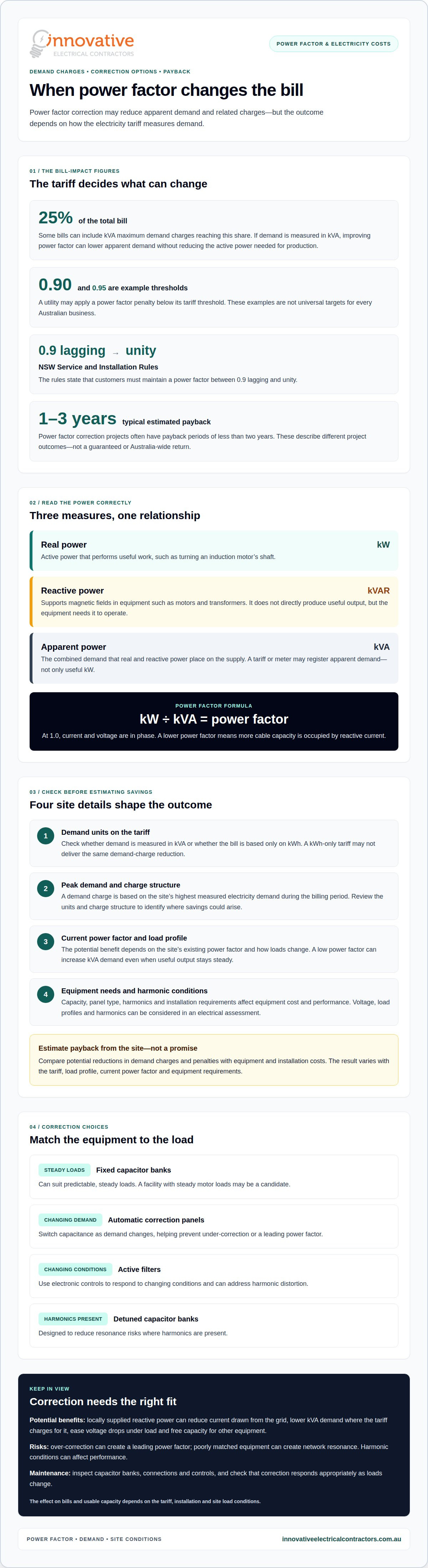
Power factor shows how effectively electrical power supports useful work. It is calculated by dividing active power, measured in kW, by apparent power, measured in kVA. At a power factor of 1.0, current and voltage are in phase. A lower power factor means more of a cable’s capacity is occupied by reactive current rather than being available for productive work.
Induction motors and other inductive loads can create a lagging power factor. Capacitors supply reactive power locally, reducing the amount drawn from the grid. This can lower current through cables and transformers, ease voltage drops under load and free capacity for other equipment. Power factor correction can ease pressure on electrical infrastructure, but its effect on usable capacity depends on the installation.
Fixed capacitor banks suit predictable, steady loads. Automatic power factor correction panels switch capacitance as demand changes, helping prevent under-correction or a leading power factor. Active filters use electronic controls to respond to changing conditions and can address harmonic distortion. Detuned capacitor banks are designed to reduce resonance risks where harmonics are present. Each option works differently, so the right configuration depends on load patterns, power quality and the installation.
The cost of power factor correction equipment in Australia depends on the installation. Capacity, panel type, harmonic conditions and installation requirements all affect the cost, which is determined through a quote.
Risks include over-correction, which can create a leading power factor, and network resonance if equipment is poorly matched to the electrical system. Maintenance involves inspecting capacitor banks, connections and control equipment, and checking that correction responds appropriately as loads change.
For example, a facility with steady motor loads may suit fixed capacitors, while a site with changing demand may need an automatic panel. Working with commercial contractors such as JK Canning Electrical for a detailed electrical assessment can help evaluate voltage, load profiles and harmonics before equipment is selected. Correct sizing helps maintain equipment performance and makes operational cost savings from power factor correction more achievable.
Utility demand charges and power factor penalties
Australian electricity tariffs can charge for peak demand as well as energy consumption. Whether power factor affects the bill depends on the tariff and how it measures demand.
Demand Charges and Bill Savings
A demand charge is based on a site’s highest measured electricity demand during the billing period. Where a tariff measures demand in kVA, improving power factor can lower apparent demand without reducing the active power needed for production.
That result illustrates why the tariff matters: businesses billed only on kWh may not gain the same demand-charge reduction. Some bills can include kVA maximum demand charges reaching 25% of the total bill. Reviewing the demand units and charge structure helps show where electricity savings could arise.
Penalties for Poor Power Factor
A power factor penalty is an additional charge a utility may apply when a customer falls below its tariff threshold. Example thresholds include 0.90 and 0.95, but they aren’t universal targets for every Australian business. Under the NSW Service and Installation Rules, customers must maintain a power factor between 0.9 lagging and unity.
A power factor below 0.9 can increase kVA demand and electricity charges, even if the site’s useful output stays steady. Poor correction can also leave unnecessary current draw, adding strain to electrical infrastructure. Harmonic conditions matter too, because they can affect how correction equipment performs. Check the tariff’s threshold and demand basis together to understand which charges improving power factor could influence.
Payback Period for Correction
Payback period is the time required for bill savings to recover the cost of correction equipment and installation. A typical estimate is 1-3 years, while power factor correction projects often have payback periods of less than two years. These figures describe different project outcomes, not a fixed Australian-wide return.
To estimate the benefit, compare potential reductions in demand charges and penalties with the project cost. The result depends on the site’s load profile, tariff, current power factor and equipment requirements. Lower demand charges may also help a business make more effective use of existing electrical infrastructure instead of carrying avoidable costs from low power factor.
Power factor and real versus apparent power
Electrical loads draw power in different forms, and understanding the distinction helps explain what a meter records. An induction motor is a practical example of how useful work and magnetic fields affect the electrical system.
Real, Reactive and Apparent Power
Real power, also called active power, performs useful work, such as turning an induction motor’s shaft. It is measured in kW. Reactive power, measured in kVAR, supports magnetic fields in equipment such as motors and transformers. Although it does not directly produce useful output, the equipment needs it to operate.
Apparent power, measured in kVA, represents the combined demand that real and reactive power place on the supply. Power factor is the ratio of real to apparent power: divide kW by kVA. For example, a motor installation that needs substantial reactive power can draw more apparent power than its active work alone suggests.
This distinction matters because a meter or tariff may register apparent demand, not just the kW used for useful work. Two sites running similar production equipment can therefore place different demands on their electrical supply if their power factors differ.
Balancing Reactive and Apparent Power
Balancing reactive power means supplying some of it near the load instead of drawing the full amount through the network. Capacitors can provide this local support for an inductive load such as a motor, reducing the reactive power drawn from the supply.
As reactive demand falls, apparent power can fall while the motor continues to deliver the same active work. This can reduce current through parts of the electrical system and leave more capacity for other loads. The extent of the change depends on the equipment and the load operating at the time.
Correction needs to suit the site. A fixed capacitor may suit a steady motor load, while changing loads may need a panel that switches capacitor stages as demand shifts. Too much capacitance can create a leading power factor, so the aim is to match support to the site, not simply add as much as possible.
Apparent demand measured in kVA
Apparent demand measures the combined effect of active and reactive power, in kilovolt-amperes (kVA). An Australian facility example shows how poor power factor can raise that figure without increasing useful output. At peak demand of 800 kW and an average power factor of 0.75, apparent demand reached 1067 kVA. After correction to 0.98, demand was 816 kVA.
The difference matters when an electricity tariff charges for maximum kVA demand. A meter records the facility’s peak, so a brief period of high demand can affect charges for the billing period. This is separate from energy consumption, commonly measured in kWh. Lowering apparent demand can reduce the measured peak, but it does not mean the site used less active power to run its equipment.
Inductive equipment, including motors, can add reactive demand. A correctly sized capacitor bank supplies some reactive power locally, helping reduce the kVA drawn from the network. The potential effect depends on the load operating at peak, not just total monthly consumption. Steady and frequently changing loads can produce different demand patterns, so consider the equipment and tariff together.
Load balancing also matters. In one example, phase current imbalance was 42.9 A, a sign that a single total-demand figure may not show how evenly the electrical load is distributed. Reviewing demand across phases can help identify where current is concentrated and how transformers and other equipment are being used. This supports a more accurate view of capacity and peak demand, rather than relying on kWh alone.
For a site-specific view of kVA demand, arrange an electrical demand assessment to examine its load profile and electrical system.
Innovative Electrical Contractors
Innovative Electrical Contractors provides commercial electrical work and services for businesses reviewing their power use. If your bill includes kVA demand charges or your equipment places extra demands on the electrical system, understanding your site’s loads is a useful next step. The tariff, operating patterns and electrical setup all influence whether power factor correction may be relevant.
Innovative Electrical Contractors can help businesses assess their electrical requirements as part of their wider commercial electrical needs. This is particularly useful when equipment or operating conditions change and demand patterns shift. The aim is to understand the system and the work required, rather than assume correction suits every site.
For advice about your business’s electrical requirements, contact Innovative Electrical Contractors.
Make your next energy decision with clarity
Use your next electricity bill as a starting point for a more informed discussion about site performance. The tariff, operating schedule and electrical load profile can help determine whether correction deserves attention alongside other efficiency priorities. An assessment can also help distinguish a persistent demand issue from a temporary change in production or equipment use.
The potential for operational cost savings from power factor correction depends on how your site operates and how its electricity charges are structured. A site-specific assessment is more useful than a general payback estimate. Innovative Electrical Contractors can discuss your commercial electrical requirements and help you consider practical next steps for your electrical system.
Contact Innovative Electrical Contractors to discuss your site’s electrical needs. A clear understanding of your operating demands can help you move forward with confidence.
Frequently Asked Questions
What are the key benefits?
Power factor correction can reduce current flowing through an electrical installation and free capacity for other loads. For a business planning to add motor-driven equipment, that capacity may help make better use of existing infrastructure. Correction can also reduce kVA-based demand charges or low-power-factor penalties where these apply. The practical benefit depends on the site’s tariff and how its electrical loads operate.
Why is it important?
A site can draw more apparent power than its useful output alone suggests. This places extra demand on supply equipment and may affect how a business is charged. Understanding power factor helps businesses interpret electricity bills and plan electrical capacity as equipment or operations change. It can also help identify whether a low reading is linked to particular loads or a broader site pattern.
How does power factor correction reduce electricity costs in Australia?
Correction can lower measured kVA demand while a site continues using the active power needed for its work. This may reduce charges where an Australian electricity tariff bills maximum demand in kVA or applies a low-power-factor penalty. It does not necessarily reduce energy consumption measured in kWh. Focus on demand charges and any power-factor-related charges, rather than consumption charges alone.
What are typical power factor correction savings for Australian commercial and industrial sites?
There isn’t one typical savings figure for every Australian commercial or industrial site, because tariffs and load profiles differ. Poor power factor can increase electricity costs by 20-25% for some Australian businesses. That figure describes a possible cost increase, not a guaranteed saving after correction. To estimate the opportunity, distinguish demand charges from energy charges and consider when the site reaches peak demand.
How can I calculate savings from correcting a site's power factor?
Start with the site’s measured kW and power factor, then estimate apparent demand using kVA = kW ÷ power factor. Compare the current kVA peak with the forecast after correction under the same operating conditions. Apply the tariff’s kVA demand rate to the difference, then include any avoided power-factor penalty. Assess demand across representative operating patterns, since a single reading may not reflect the billing peak.
When can power factor correction increase costs or cause resonance and harmonic problems?
Costs can rise if a capacitor bank is oversized, poorly matched to changing loads or installed without accounting for existing power-quality conditions. Excess capacitance can create a leading power factor, while interaction between capacitors and the electrical network can cause resonance. Harmonics from electronic equipment can worsen these interactions. Qualified teams such as Inlightec Electrical Solutions can help assess load behaviour and harmonic levels to determine whether detuned capacitors or active filtering are appropriate.


Comments