
Rooftop Solar for Homes: 2026 Australian Energy Guide

Approximately one in three Australian homes now have rooftop solar installed. In 2026, rooftop solar for homes is no longer just a trendy "add-on" for the environmentally conscious; it is the essential foundation of a modern home electrical ecosystem. We know that while the potential for savings is huge, the path to getting there often feels cluttered with confusing jargon and technical data. You might be worried about "solar cowboys" or wondering if the marketing claims about slashing your bills are actually achievable for your specific property.
It is completely normal to feel cautious when investing in your home's future. This guide will show you exactly how to plan, fund, and install a system that provides genuine energy independence and slashes your power bills. We will cut through the noise to explain the latest 2026 regulations, including the new mandatory photo documentation for installations and the updated STC phase-out rates. By the end of this guide, you will have a clear roadmap to secure a reliable, high-quality system installed by qualified professionals who prioritise safety and long-term performance.
Table of Contents
What is Rooftop Solar for Homes and How Does it Work?
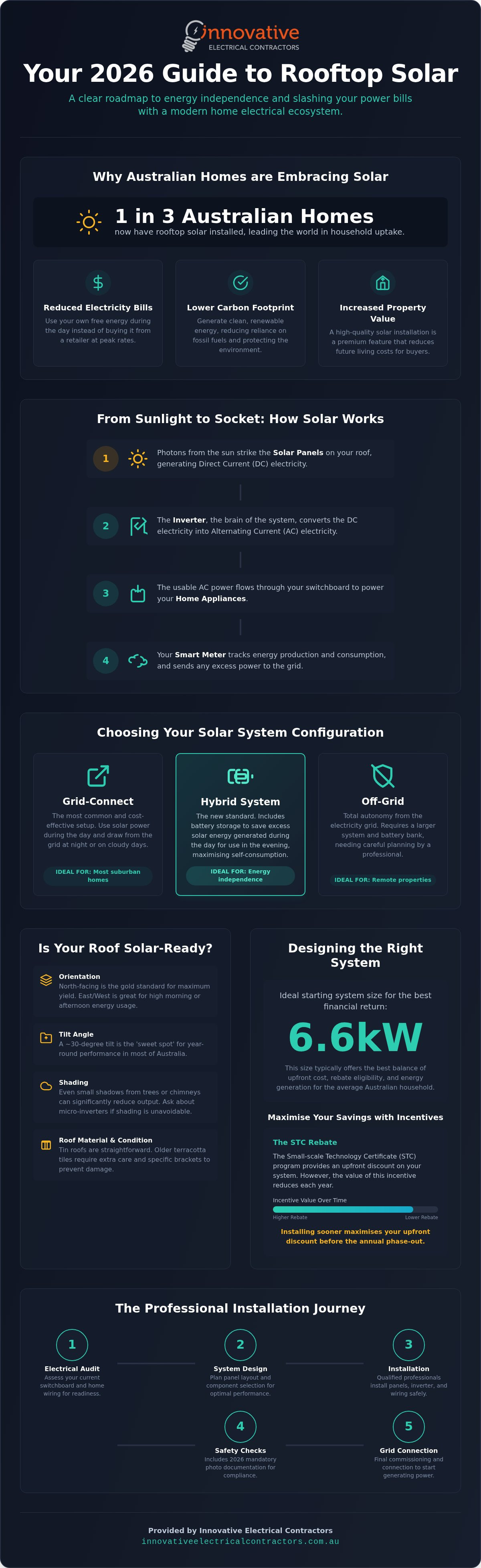
Australia enjoys some of the highest solar radiation levels on the planet. This natural advantage makes rooftop solar for homes an exceptionally effective investment for most households. Solar Photovoltaic (PV) technology works by capturing sunlight and converting it into electricity through a process that is both silent and efficient. The journey begins when a photon travels from the sun and strikes a solar cell on your roof. This interaction creates an electrical field, generating the power needed to run everything from your fridge to your toaster.
Australia leads the world in household solar uptake because our climate and energy market create a "perfect storm" for savings. With approximately one in three Australian homes already hosting a system, it is a proven technology that delivers three primary benefits:
Reduced Electricity Bills: You use your own free energy during the day instead of buying it from a retailer at peak rates.
Lower Carbon Footprint: You generate clean, renewable energy right where it is consumed, reducing reliance on coal-fired power.
Increased Property Value: Many Australian buyers now view a high-quality solar installation as a premium home feature that reduces future living costs.
The Core Components of Your System
A reliable solar setup relies on three main parts working in harmony. Solar panels are the most visible component; they are responsible for converting light into Direct Current (DC) electricity. However, your home runs on Alternating Current (AC). This is where the inverter comes in. As the "brain" of the system, the inverter manages the flow of power and converts it into a usable form for your appliances. Finally, a smart meter tracks your energy usage in real-time. Understanding What is Rooftop Solar Power requires looking at how these components integrate with your existing switchboard to provide a seamless energy supply.
Grid-Connect vs Hybrid vs Off-Grid
Choosing the right configuration depends on your location and your goals for energy independence. Most suburban households choose a standard grid-connect system. It is cost-effective and allows you to draw power from the grid when your solar production is low, such as during heavy rain or at night. This setup is the simplest way to start your solar journey.
Hybrid systems are rapidly becoming the new standard for modern homes. These systems include battery storage, allowing you to save excess energy generated during the day for use in the evening. For those in remote areas or seeking total autonomy, off-grid solutions provide complete independence. These setups are more complex and require careful planning by a professional electrical contractor to ensure they can handle your peak loads without any grid support.
Assessing Your Property: Is Your Roof Solar-Ready?
Before committing to rooftop solar for homes, a thorough site assessment is essential. Your roof's physical characteristics dictate how much energy you can actually harvest. While North-facing roofs remain the gold standard for maximum daily yield, East and West orientations are increasingly popular for households with high energy use in the morning or late afternoon. Choosing the right layout ensures you generate power when your family needs it most.
Roof materials also play a significant role in installation complexity. Tin roofs are generally the most straightforward for mounting systems, whereas older terracotta tiles require extra care and specific brackets to prevent cracking. Shading is another critical factor. Even a small amount of shade from a chimney or a neighbouring tree can significantly drop the output of a traditional string inverter system. We always recommend reading your "bill of health" by reviewing your last four quarterly electricity statements to understand your seasonal consumption patterns.
Orientation and Tilt Optimisation
In most parts of Australia, a 30-degree tilt is considered the "sweet spot" for year-round performance. Solar insolation is the measure of solar energy hitting your roof area. When designing your solar system, we look at whether your roof pitch is already ideal or if tilt frames are necessary. If shading is unavoidable, we often suggest using micro-inverters or DC optimisers. These components allow each panel to operate independently, ensuring one shaded module doesn't drag down the performance of the entire array.
Electrical Infrastructure Readiness
A common hurdle many homeowners face is an outdated electrical setup. Your current switchboard must be capable of handling the two-way flow of electricity between your home and the grid. In many older properties, this requires a professional intervention. Understanding Why Your Home Needs an Electrical Switchboard Upgrade is vital, as modern solar inverters require specific safety switches and circuit breakers that older boards simply don't have.
We also need to determine if your home has single-phase or 3-phase power. Single-phase is standard for most small to medium homes, but larger systems typically require 3-phase power to comply with grid regulations. Checking these details early prevents unexpected costs during the installation phase. If you're unsure about your current capacity, our team can provide a comprehensive electrical audit to ensure your home is ready for a modern energy upgrade.
Designing the Right Solar System for Your Lifestyle
Designing a system for rooftop solar for homes has evolved beyond simply covering a roof in panels. Today, we focus on matching energy production with your family's daily habits. While a 6.6kW system remains a common entry point, many Australian households are now opting for 10kW or larger arrays. This shift is driven by the rapid adoption of electric vehicles (EVs) and the transition away from gas toward electric heating and induction cooking. Oversizing your system ensures you have enough "fuel" to power your home and your car without relying on the grid during expensive peak periods.
Quality hardware is the bedrock of a long-term investment. We always recommend Tier 1 panels, which offer better degradation rates and stronger warranties than budget alternatives. The inverter choice is equally critical. String inverters are efficient and cost-effective for simple roof layouts, but micro-inverters provide superior monitoring and flexibility if you plan to expand your system later. For some suburban homeowners, the goal is now moving toward a "quasi-off-grid" setup. This involves installing enough capacity and storage to remain largely independent and protected from blackouts, even in a connected street.
To Battery or Not to Battery?
In 2026, the economics of solar batteries have shifted significantly. With feed-in tariffs remaining low, the real value lies in maximising self-consumption. A battery allows you to store the energy you generate at midday to power your home during the expensive evening peak. It's a strategic move for energy independence. However, a battery is a sophisticated electrical component that requires regular attention. Following Solar Battery Maintenance: The Essential Guide is vital to ensure your storage system reaches its full lifespan and maintains its safety standards.
Smart Energy Management Systems
Modern solar is only truly effective if you have the right tools to manage it. Smart energy management systems allow you to monitor production and consumption via mobile apps in real-time. You can automate high-draw appliances, like your dishwasher or pool pump, to run exactly when your solar production peaks. Integrating your system with your air conditioning is another game-changer. By pre-cooling your home during the day using solar power, you reduce the load on your battery at night. This methodical approach ensures every watt you generate is used efficiently, providing the best possible return on your investment.
Navigating Australian Solar Rebates and Incentives in 2026
The financial landscape for rooftop solar for homes in 2026 remains supportive, but the structure of incentives is evolving. The primary mechanism is the Small-scale Renewable Energy Scheme (SRES), which generates Small-scale Technology Certificates (STCs). These certificates act as a direct discount on the upfront cost of your system. For a standard 6.6kW setup, this rebate can be worth approximately $3,000 depending on your specific solar zone. However, the value of STCs reduces every year on January 1st as part of a scheduled phase-out ending in 2031. Waiting until next year literally means paying more for the exact same hardware.
State governments also provide additional layers of support to help households manage the transition. For instance, the NSW Empowering Homes program offers subsidised loans for solar-battery systems, while the ACT provides interest-free loans up to $15,000. Western Australia also supports storage through the WA Home Battery Scheme. Feed-in Tariffs (FiTs) have stabilised in the 4c to 8c per kWh range. While exporting power still provides a credit, the modern strategy is to prioritise self-consumption to avoid high retail rates.
How to Claim Your Solar Discount
Claiming your rebate is usually a seamless process handled by your installer. They act as a registered agent, deducting the STC value from your quote so you only pay the "net" price. To be eligible, your system must be installed by a Clean Energy Council (CEC) accredited professional. This accreditation is your safeguard against "solar cowboys" and ensures the installation meets strict Australian standards. Be wary of telemarketing offers claiming "government-funded free solar". Real rebates are applied as discounts by reputable contractors, not handed out as cash over the phone.
Maximising Your Return on Investment
The average payback period for a residential system in 2026 is between 3 and 6 years. This timeline is accelerating as retail electricity prices continue to rise across the national grid. The introduction of the federal battery rebate, which offers a discount of approximately 30% on eligible storage systems, has significantly improved the financial case for batteries within rooftop solar for homes. By storing your midday sun for evening use, you protect yourself from peak-hour energy costs. If you want to see how these incentives apply to your property, request a custom quote from Innovative Electrical Contractors for a detailed financial projection.
The Installation Journey: What to Expect
Installing rooftop solar for homes is a methodical process that requires precision at every stage. It isn't just about placing panels on a roof; it's a complete electrical integration. The journey begins with a comprehensive site audit. During this visit, a professional contractor verifies the structural integrity of your roof and the health of your existing electrical system. They'll check your switchboard and earthing to ensure your property can safely handle the new energy flow. Following this, you'll receive a detailed proposal including an energy yield projection, which shows exactly how much power your specific layout will generate throughout the year.
Once you approve the design, the administrative phase starts. This involves securing necessary approvals and applying for grid connection with your Distributed Network Service Provider (DNSP). On the actual installation day, a team of qualified electricians will install the mounting rails, secure the panels, and complete the complex wiring. Since March 1, 2026, all accredited installers must provide geotagged and timestamped photos of critical labelling for every installation. Finally, the system is commissioned and tested. Your installer will walk you through the handover, explaining how to operate the isolation switches and ensuring your inverter complies with the latest grid stability standards.
Choosing a Reliable Electrical Contractor
The quality of your installation depends entirely on the expertise of your contractor. Solar is a high-voltage electrical system, so choosing a licensed electrical contractor matters far more than just finding someone to lay panels. You should always verify their Clean Energy Council accreditation and check for local Australian warranties. A reliable expert won't just disappear after the last bolt is tightened. They provide genuine after-sales support and clear maintenance schedules to protect your long-term investment. This commitment to safety and high standards is what separates a professional installation from a budget job that might fail in a few years.
Post-Installation: Connection and Monitoring
Your journey doesn't end when the installers leave. Most homes require a smart meter upgrade to properly track the electricity you export back to the grid. This process is usually coordinated through your energy retailer. Once your system is live, you'll need to set up your monitoring software. These mobile apps provide total transparency, showing you exactly when your panels are peaking and how much energy your household is consuming. Reading your first post-solar bill can be a surprise. Look for the "Solar Export" or "Feed-in" line to see your credits. By monitoring this data, you can fine-tune your habits to ensure you're getting the best possible return on your rooftop solar for homes.
Secure Your Energy Independence Today
Transitioning to rooftop solar for homes is the most effective way to shield your household from rising energy costs. By choosing the right orientation, right-sizing for future EV needs, and moving before the next STC phase-out, you turn your roof into a high-performing asset. A successful installation requires more than just laying panels. It demands a methodical approach to your home's entire electrical health to ensure long-term safety and performance.
Innovative Electrical Contractors provides comprehensive electrical and solar expertise to guide you through this transition. Our CEC Accredited Installers specialise in full system integration, connecting your solar, battery, and air conditioning into one efficient ecosystem. We handle everything from the initial site audit to the final grid connection. This commitment to excellence ensures your system is reliable and built to last.
Ready to take control of your energy future? Get a professional solar assessment from Innovative Electrical Contractors today and start your journey toward a self-sufficient home. It's time to make the sun work for you.
Frequently Asked Questions
How much does rooftop solar for homes cost in Australia in 2026?
The investment for rooftop solar for homes varies depending on the system size and hardware quality you choose. While government rebates like STCs provide a significant upfront discount, your final quote will reflect site-specific factors such as roof material and switchboard condition. It's best to focus on the long-term payback period, which typically ranges between three and six years for most Australian households. High-quality components ensure better performance over the system's life.
Will solar panels still work on cloudy or rainy days?
Solar panels continue to generate electricity during cloudy or rainy weather, although their output is naturally lower than on a clear day. Photovoltaic cells use light, not just direct heat, so even diffused sunlight through cloud cover produces power. Heavy rain can actually be beneficial as it washes away dust and debris that might be blocking the cells. Your monitoring app will show you exactly how much your production fluctuates during these periods.
Do I need to clean my solar panels regularly?
Most Australian homeowners find that regular rainfall is sufficient to keep their panels clean and performing well. You only need to consider professional cleaning if you live in a particularly dusty area or if bird droppings have accumulated on the glass. A simple visual check from the ground once or twice a year is usually enough. Never climb onto your roof yourself; instead, hire a professional if you notice a significant drop in production.
What happens to my solar system during a power outage?
A standard grid-connected system will automatically shut down during a power outage to protect utility workers from "islanding" or back-feeding the grid. If you require power during a blackout, you'll need a hybrid system with battery storage and a specific backup circuit. These setups allow your home to draw from stored energy even when the main grid is down. This provides essential peace of mind for families in areas prone to network instability.
Can I add more panels to my existing rooftop system later?
You can often expand your rooftop solar for homes, but it isn't always as simple as adding more panels. Your existing inverter has a maximum capacity, so adding extra modules might require a second inverter or a complete system upgrade. We also need to assess if your remaining roof space has the right orientation for more panels. It's often more cost-effective to install a slightly larger system from the beginning to allow for future growth.
How long do modern solar panels and inverters actually last?
Modern solar panels are designed to last 25 years or longer, with most manufacturers providing performance warranties for this duration. While their efficiency decreases slightly over time, they continue to produce significant power well into their third decade. Inverters are the hardest-working part of the system and typically have a lifespan of 10 to 15 years. Planning for an inverter replacement mid-way through your panels' life is a standard part of solar ownership.
Is my roof strong enough to support a solar battery and panels?
Most Australian residential roofs are structurally capable of supporting the weight of a standard solar array. During our initial site audit, we verify the health of your roof trusses and mounting points to ensure everything is safe. Solar batteries are quite heavy, so they are typically installed on a concrete floor or secured to a structural wall rather than being placed on the roof. This methodical approach ensures your home remains safe and compliant.
What is the difference between a solar rebate and a feed-in tariff?
A solar rebate is an upfront discount that reduces the initial purchase price of your system through Small-scale Technology Certificates. In contrast, a feed-in tariff is an ongoing credit you receive from your electricity retailer for any excess energy you export back to the grid. While the rebate helps with the initial investment, the feed-in tariff provides long-term savings on your bills. Both incentives work together to improve your overall return on investment.


Comments