
Solar Battery Rebate 2026: The Complete Australian Homeowner’s Guide

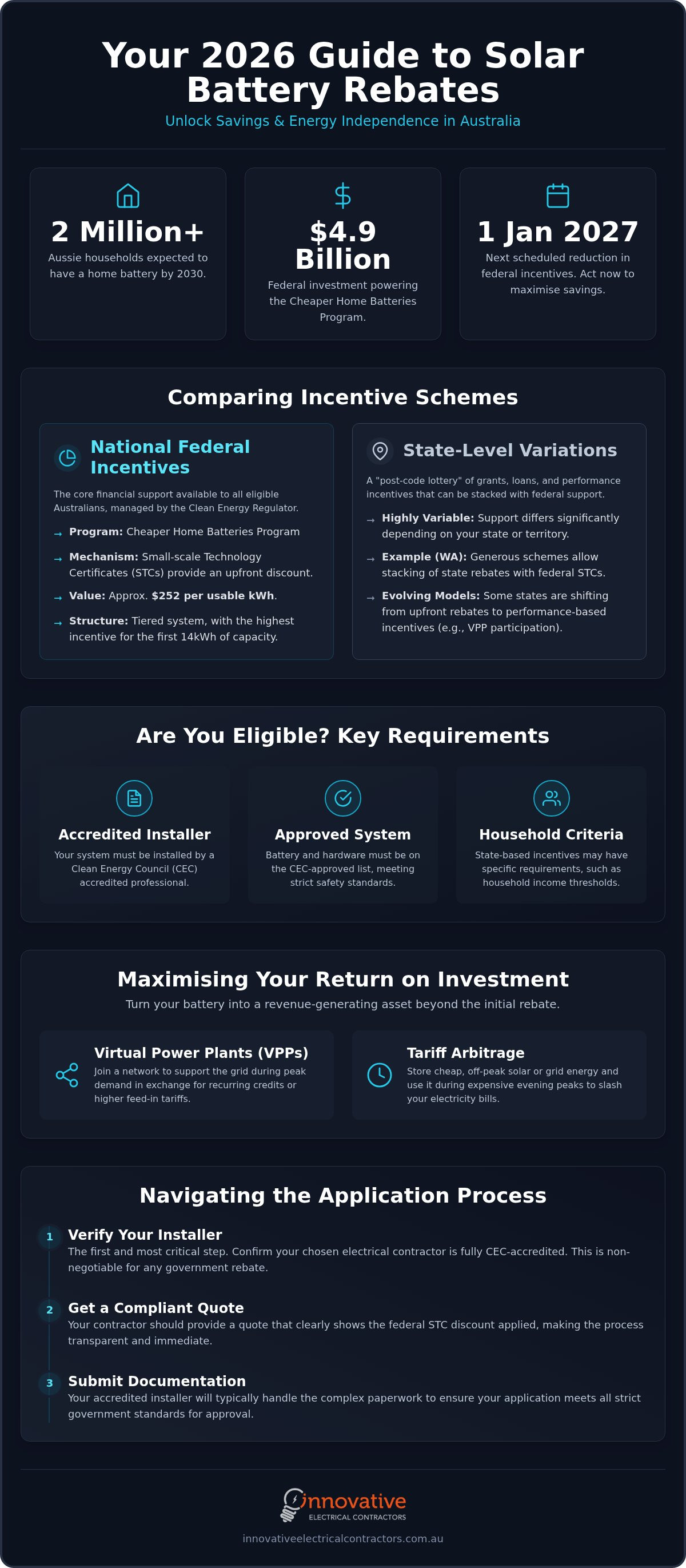
Did you know that over two million Australian households are expected to install a home battery by 2030? This massive shift is being powered by a $4.9 billion federal investment into the Cheaper Home Batteries Program. If you have been held back by high upfront costs, securing a solar battery rebate is the smartest way to make energy storage affordable. With the next scheduled reduction in federal incentives set for 1 January 2027, the time to act is now to ensure you don't miss out on the highest possible savings.
It is easy to feel overwhelmed by conflicting state rules or the fear of making a costly mistake. You want a clear path to energy independence and the confidence that your investment will actually deliver. This guide breaks down the complex landscape of 2026 incentives into a simple, actionable roadmap. We will walk you through the available federal and state supports, explain the application process, and show you how to ensure your system meets the strict safety standards required for government approval.
Table of Contents
Understanding the 2026 Solar Battery Rebate Landscape
In 2026, a solar battery rebate isn't a single government cheque. Instead, it's a sophisticated mix of financial tools designed to lower the barrier to energy storage. The primary driver is the federal Cheaper Home Batteries Program, which provides an upfront discount through Small-scale Technology Certificates (STCs). This scheme offers approximately $252 per usable kilowatt-hour (kWh) for eligible systems. The Clean Energy Regulator manages these programmes, ensuring that hardware meets strict safety standards and that installers are properly accredited. Historically, Solar power in Australia focused almost entirely on panel installation. Today, the priority has shifted to storage. This transition allows you to move toward genuine energy independence, storing your own clean power to avoid high electricity prices during evening peaks.
Why Governments are Incentivising Storage
The Australian energy grid faces a unique challenge. We generate massive amounts of solar energy during the day, but demand spikes when the sun goes down. Governments incentivise storage to "smooth" this peak demand and maintain grid stability. By installing a battery, you help prevent grid overloads and support the broader rooftop solar for homes network. These initiatives are critical for meeting Australia's 2026 environmental targets. They turn individual houses into reliable components of a modern energy system, reducing the need for expensive, fossil-fuel-based peaking power plants. It's a methodical approach to building a more resilient, community-focused power network.
The Shift from Up-front Rebates to Performance Incentives
The way you receive financial support is evolving. While the federal solar battery rebate still provides immediate relief on purchase costs, several states are moving toward performance-based models. These modern incentives reward "Smart Grid" participation. In this model, your battery can support the network during emergencies in exchange for recurring credits or higher feed-in premiums. This is a significant departure from traditional cash-back schemes. It prioritises long-term grid health over simple equipment subsidies. The 2026 rebate landscape is a hybrid of state grants and federal certificates. This dual structure ensures you get a substantial discount on day one while opening doors to ongoing revenue through Virtual Power Plant participation. It's a forward-thinking strategy that rewards you for being a proactive participant in Australia’s energy transition.
Comparing Federal and State-Based Incentive Schemes
Securing a solar battery rebate requires a clear understanding of two distinct financial tiers. The first is the federal Small-scale Technology Certificate (STC) system, which applies nationally. The second is a collection of state-specific grants, loans, and incentives that vary significantly depending on your location. For any of these schemes to be valid, you must use a Clean Energy Council (CEC) accredited installer. This ensures your system meets the rigorous safety and performance standards required for government approval. Whether you are upgrading a residential home or a commercial site, technical compliance is the foundation of every successful application.
National Federal Incentives
The federal Cheaper Home Batteries Program is the heavy lifter of the Australian market. It functions through the creation of STCs, which act as a form of renewable energy currency. When you install an integrated solar and battery system, certificates are generated based on the expected clean energy production. In 2026, these certificates follow a tiered structure. The highest incentive value applies to the first 14kWh of usable capacity, with reduced rates for larger systems. A critical factor to watch is the "deeming period," which determines how many years of future generation can be claimed upfront. This period reduces every year on 1 January, meaning certificates issued in 2026 hold more value than those issued in 2027. Most homeowners find that these incentives are bundled directly into the initial quote provided by their electrical contractor, making the discount immediate and transparent.
State-Level Variations
State programmes create what many call a "post-code lottery" for energy storage. In Western Australia, residents benefit from the ability to stack federal support with state-specific rebates, making it one of the most affordable regions for battery adoption. Conversely, New South Wales has shifted its focus. While residential upfront rebates have transitioned into Virtual Power Plant (VPP) incentives, new support for businesses and apartment buildings launched in September 2026 offers significant percentage-based discounts. States like Victoria and Queensland currently rely primarily on the federal programme after their dedicated state funds were fully allocated. These programmes often have limited seats or strict application windows. Acting quickly ensures you don't miss out when a new round of funding opens. If you are unsure which regional scheme applies to your property, a professional solar and battery consultation can clarify your local eligibility and potential savings.
Eligibility Criteria: Can You Claim the Rebate?
Qualifying for a solar battery rebate involves more than just a desire to save on power bills. You must meet a specific set of criteria that covers your property type, financial status, and the hardware you choose. While the federal Cheaper Home Batteries Program is not means-tested, some state-level incentives, such as Western Australia’s interest-free loans, apply a combined household income threshold of $210,000. It's also vital to distinguish between a new build and a retrofit. Most 2026 schemes allow you to add a battery to an existing solar array or install both simultaneously, provided the battery capacity sits between 5kWh and 100kWh. Before any work begins, you must obtain a formal grid connection offer from your local network provider to ensure your property can handle the discharge.
Property and Household Requirements
Most rebates are currently designed for owner-occupiers, but this is changing. New South Wales, for example, introduced incentives for apartment buildings and businesses in late 2026. Regardless of property type, a digital smart meter is a non-negotiable requirement. This device tracks your energy flow in real-time, which is essential for calculating rebate eligibility and performance. If your home is older, your current electrical services might need an upgrade. Switchboards must meet modern safety standards to house the additional circuit breakers required for a battery. A professional contractor will assess your board during the quote process to ensure it's compliant before you apply for funding.
Technical Compliance and Certification
The hardware itself must be on the Clean Energy Council (CEC) approved list. Not every battery chemistry or brand qualifies for government support. Most schemes favour Lithium Iron Phosphate (LFP) or similar stable chemistries due to their safety profile and longevity. You can't "DIY" this installation; it must be performed by a CEC-accredited professional who can sign off on the technical compliance. To be eligible for the solar battery rebate, your system must meet these technical standards:
The battery unit must be a CEC-approved model.
The nominal capacity must fall within the 5kWh to 100kWh range.
The installer must hold current solar and battery accreditation.
Safety compliance is the number one reason applications are rejected by the Clean Energy Regulator. Choosing an installer who handles the technical paperwork ensures that your system meets every regulatory hurdle from the start.
Maximising Your ROI: Beyond the Initial Rebate
While the upfront solar battery rebate significantly lowers your entry cost, the true return on investment (ROI) is built over the following decade. You aren't just buying hardware; you're securing a methodical hedge against the volatile Australian energy market. By using a "Time of Use" (ToU) tariff arbitrage strategy, you can program your battery to charge from the grid during off-peak hours when prices are at their lowest. You then discharge that stored energy during the expensive evening peak. This strategy, combined with your daily solar generation, can virtually eliminate your reliance on high-cost grid power. Beyond the financial savings, the value of energy independence during a grid outage is hard to quantify but provides immense peace of mind for your family. A battery ensures your lights, refrigeration, and essential services stay active when the national grid fails.
Virtual Power Plants (VPPs) Explained
Virtual Power Plants (VPPs) have become the dominant secondary incentive model in 2026. In states like New South Wales and South Australia, joining a VPP is now a primary way to access additional financial support. A VPP is a network of home batteries that work together to support the grid during periods of extreme demand. In exchange for allowing your energy retailer limited control over your battery, you receive ongoing credits on your bill. This functions as a recurring "rebate" that continues long after the initial installation. While some homeowners are hesitant to give up total control, the financial rewards often outweigh the occasional use of your stored energy by the network. It's a community-focused approach that rewards you for helping to stabilise the local power supply.
Long-Term Asset Protection
Protecting your investment is essential for long-term ROI. Regular solar battery maintenance ensures your system operates at peak efficiency and reaches its full warranted lifespan. Extreme temperatures and aggressive cycling can degrade battery chemistry faster than expected. Use your monitoring software to track these metrics in real-time. This gives you total visibility over your daily savings and alerts you to any performance dips before they become costly repairs. A well-maintained battery doesn't just save you money; it remains a reliable asset that adds tangible value to your property for years to come. Methodical care now prevents expensive component failures later.
If you want to ensure your system is configured for maximum savings, speak with our specialised solar and battery team to design a high-performance solution for your home.
Navigating the Application and Installation Process
Moving from research to a fully functional system requires a methodical approach to both hardware and paperwork. The journey to securing a solar battery rebate follows a strict sequence of events. It's a disciplined process, but having a methodical partner makes it straightforward. You don't have to tackle the bureaucracy alone. Most homeowners find that the technical requirements are best handled by their chosen professional. Following these steps ensures you don't miss out on available funding due to a simple administrative error.
Step 1: Obtain a detailed quote from a specialised solar and battery installer who understands the current 2026 regulations.
Step 2: Verify the installer’s credentials and ensure the proposed hardware is on the Clean Energy Council (CEC) approved list.
Step 3: Submit the portal application. In most cases, your contractor will manage this submission to ensure all technical data is accurate.
Step 4: Coordinate the installation and the subsequent mandatory safety inspection.
Step 5: Finalise the rebate claim and confirm your new grid connection agreement with your energy retailer.
The Role of Your Electrical Contractor
A professional installer is more than just a technician; they are your compliance manager. They handle the complex technical paperwork required by the Clean Energy Regulator. One of the most critical documents they provide is the Certificate of Electrical Safety (CES). This certificate is your proof that the installation meets Australian Standards and is a non-negotiable requirement for finalising your solar battery rebate. You must realise that a faulty installation or using non-approved components can void your eligibility entirely. It’s vital to choose a partner who values precision and safety above all else. This ensures your system is not only eligible for incentives but also safe for your family for years to come.
Post-Installation Steps
Once the physical work is complete, there are a few final tasks to wrap up. You must register your system with the relevant state energy body to confirm the installation is active. Your installer will also help you set up a monitoring app. This allows you to see your energy storage in real-time and confirm the system is performing as promised. It’s the final piece of the puzzle that gives you total visibility over your energy independence. Take the time to understand the data; it’s the best way to verify that your investment is delivering the expected ROI.
Ready to secure your incentive? Enquire with Innovative Electrical Contractors today to start your journey toward energy independence with a team you can trust.
Securing Your Energy Independence in 2026
The 2026 energy landscape offers a clear window of opportunity for Australian households. By combining federal STCs with regional incentives, you can significantly reduce the cost of storage while protecting your home against rising electricity tariffs. Remember that eligibility hinges on using CEC-accredited hardware and certified installers who can guarantee technical compliance. Acting before the scheduled reduction in the solar battery rebate on 1 January 2027 ensures you maximise your financial return.
Securing these incentives requires a methodical partner who understands the strict safety standards required for government approval. At Innovative Electrical Contractors, we are CEC Accredited Installers with national expertise in electrical safety. We specialise in off-grid and hybrid storage solutions, handling the complex paperwork so you don't have to. Our team ensures your system is configured for peak performance and long-term reliability.
Get a Professional Solar Battery Quote and Rebate Assessment
Taking control of your power today builds a more resilient future for your home. We look forward to helping you achieve genuine energy independence.
Frequently Asked Questions
How much can I actually save with a solar battery rebate in 2026?
You can save a significant amount through the federal Cheaper Home Batteries Program, which offers approximately $252 per usable kilowatt-hour of capacity. For a standard 10kWh system, this translates to a substantial upfront discount applied by your installer. While hardware prices vary, this solar battery rebate reduces the initial capital required. Some states allow you to stack this with local grants, further increasing your total savings depending on your specific location and system size.
Can I claim a battery rebate if I already have solar panels installed?
Yes, you can claim a rebate for adding a battery to an existing solar PV system. The current federal incentives are designed to support both new installations and retrofits, provided the battery capacity is between 5kWh and 100kWh. This allows homeowners who already have panels to upgrade their storage and increase their energy independence. Your installer will need to verify that your existing solar array is compatible with the new battery technology.
What is the difference between a rebate and a Virtual Power Plant incentive?
A rebate is an upfront discount on the purchase price of your system, whereas a Virtual Power Plant (VPP) incentive is an ongoing financial reward. Rebates, like the federal STC scheme, lower the initial cost of the hardware at the point of sale. VPP incentives involve joining a network that supports the grid during peak demand in exchange for recurring bill credits. Many Australian homeowners now choose to combine both to maximise their long-term returns.
Are there any interest-free loans available for solar batteries in Australia?
Interest-free loans are available in specific regions, such as Western Australia, where eligible households can access up to $10,000 for battery storage. Other areas, like the Australian Capital Territory, offer low-interest loans through the Sustainable Household Scheme to help spread the cost of energy upgrades. Because these programmes are often limited by funding cycles or income thresholds, it's important to check the current availability in your state before starting your application process.
How long does the application process for a solar battery rebate take?
The application process typically takes between two to six weeks from the initial quote to final approval. Most of this timeline involves the technical review of your grid connection offer and the verification of your hardware's eligibility. Because your electrical contractor handles the majority of the portal submissions, the process is relatively hands-off for the homeowner. Once approved, the installation can proceed, and the final rebate claim is settled shortly after the safety inspection.
Do I need to upgrade my switchboard to qualify for a battery rebate?
Many older Australian homes require a switchboard upgrade to meet the strict safety standards necessary for a solar battery rebate. Your switchboard must be capable of housing new circuits and safety switches that comply with current electrical regulations. An accredited installer will assess your board during the quoting stage to ensure it can safely manage the battery's charge and discharge cycles. This upgrade is a vital step in securing government approval for your incentive.
Is it better to wait for battery prices to drop or claim a rebate now?
Waiting for hardware prices to drop is a common strategy, but it's important to consider that rebate values are scheduled to decrease. The federal incentive reduces every year on 1 January as part of the "deeming period" phase-out. By acting now, you secure the higher 2026 rebate rates before the next reduction in 2027. This often outweighs the potential for future price drops, allowing you to start saving on your power bills immediately.
What happens to my rebate if I move house or sell the property?
The rebate is tied to the installation of the system at a specific property and is finalised at the time of purchase. If you sell your house, the battery system remains with the property as a permanent fixture, similar to your solar panels. While you cannot "take the rebate with you" to a new home, the presence of a subsidised, high-performance battery storage system often increases the market value and appeal of your property to future buyers.


Comments